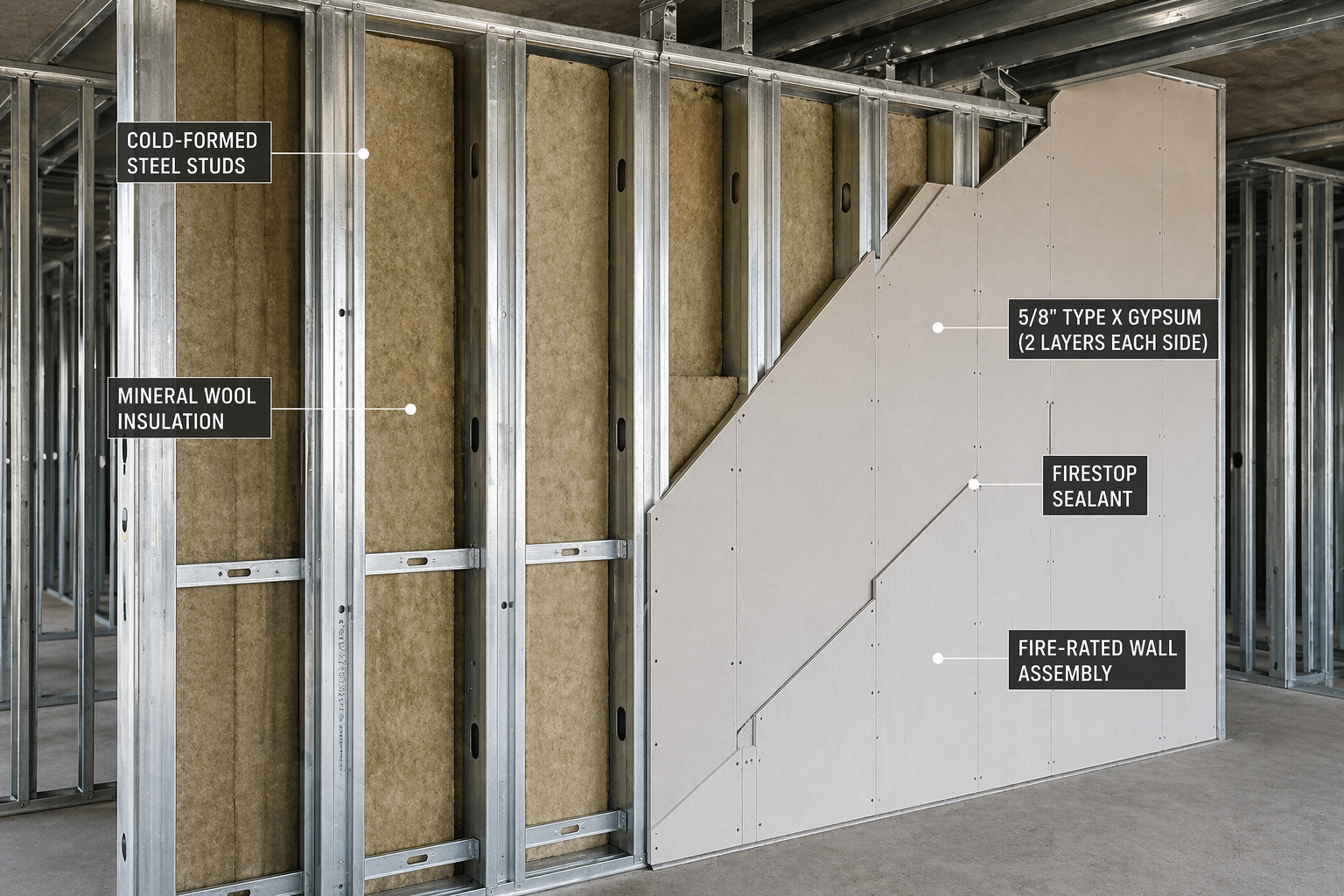
Sound-Rated Wall and Floor Assemblies for Cold-Formed Steel in Multifamily and Hotels

Acoustic complaints rarely show up in the pro forma, but they can become very real once a building is occupied.
In multifamily and hotel construction, residents and guests do not judge wall assemblies by their engineering logic. They judge them by what they hear. Footsteps from the level above. Plumbing noise in the middle of the night. TV sound through a corridor wall. Doors slamming. Conversations bleeding between adjacent units.
That is why sound-rated wall and floor assemblies deserve early attention in cold-formed steel projects. Not because they are a niche code issue, but because they directly affect user experience, brand perception, warranty exposure, and rework risk. In practice, acoustic performance is not just about selecting an assembly with a target rating. It is about coordinating framing, insulation, gypsum layers, clips, channels, penetrations, and transitions so the tested assembly still performs after installation.
For developers, architects, and GCs working in multifamily and hospitality, that distinction matters. A sound-rated assembly on paper is one thing. A sound-rated assembly that survives design changes, trade coordination, and field execution is something else.
Why Acoustic Coordination Matters More in Cold-Formed Steel Projects
Cold-formed steel framing can support highly repeatable, precise wall and floor systems. That is a major advantage in projects where acoustic separation is critical across dozens or hundreds of repeated rooms.
But steel framing also changes the conversation. Because steel is light and efficient, acoustic performance typically depends on the full assembly rather than on mass alone. The framing members, cavity insulation, gypsum layers, resilient attachment methods, floor underlayment, and perimeter sealing all work together. If one component changes, the acoustic result can change with it.
This is where many projects get into trouble. Teams may assume that “more insulation” or “extra drywall” automatically solves the problem. In reality, sound control is more specific than that. The tested path to performance often depends on exactly how the system is built, not just what materials are present.
For panelized or pre-engineered cold-formed steel systems, that makes early coordination even more valuable. When the assembly is resolved upstream, the project is less dependent on jobsite improvisation later.
What “Sound-Rated Assembly” Actually Means
When teams talk about sound-rated assemblies, they are usually referring to one or both of these performance measures:
STC: Sound Transmission Class
STC measures how well a wall or floor-ceiling assembly reduces airborne sound transmission. Think voices, TVs, music, or general room noise. Higher STC values indicate better performance.
In multifamily and hotel contexts, STC becomes especially important at:
- Demising walls between dwelling units or guest rooms
- Corridor walls adjacent to units
- Walls separating units from mechanical or service spaces
- Floor-ceiling assemblies between occupied levels
IIC: Impact Insulation Class
IIC measures how well a floor-ceiling assembly reduces impact noise, such as footsteps, dropped objects, or furniture movement. This matters most for stacked occupancies, especially where hard surface flooring is used.
A project may meet airborne sound expectations yet still perform poorly for impact sound if the floor system, underlayment, or ceiling isolation is not handled properly.
The practical point is simple: STC and IIC are different problems. Good performance in one does not guarantee good performance in the other.
Where Sound-Rated Assemblies Matter Most
In multifamily and hotel construction, the highest-risk locations are predictable.
Unit-to-unit demising walls
These walls carry some of the highest occupant expectations in the building. Even minor coordination mistakes can lead to noticeable sound transfer, especially around back-to-back devices, pipe penetrations, or poorly sealed head-of-wall conditions.
Guest room separation walls in hotels
Hotels often have tighter expectations for privacy because the end users are transient and less tolerant of acoustic issues. A guest hearing a neighboring television or conversation may not understand why. They only know the room feels cheap.
Corridor walls
Corridors generate rolling carts, doors, conversation, housekeeping traffic, and general activity. The wall between the corridor and a unit or room may require more attention than teams initially assume.
Floor-ceiling assemblies between levels
This is where both airborne and impact sound come into play. Structure, subfloor, underlayment, ceiling treatment, and MEP penetrations all affect the result.
Walls adjacent to mechanical or service spaces
Elevator equipment areas, trash rooms, laundry rooms, pump rooms, and MEP spaces can all create recurring acoustic complaints if not separated correctly.
Why Tested Assemblies Matter
One of the most common mistakes in acoustic design is treating ratings as mix-and-match.
Most dependable sound-rated wall and floor systems are based on tested assemblies. That means the published performance comes from a specific configuration of studs, spacing, insulation type, board layers, channels, clips, floor toppings, ceiling components, and sealants. Change one variable and the performance may no longer align with the tested result.
That does not mean every project must copy a test exactly without adjustment. It means the team should understand which parts of the assembly are doing the acoustic work and which substitutions are risky.
For example, the following items can materially change performance:
- Stud depth or gauge
- Framing spacing
- Type and thickness of cavity insulation
- Number and type of gypsum layers
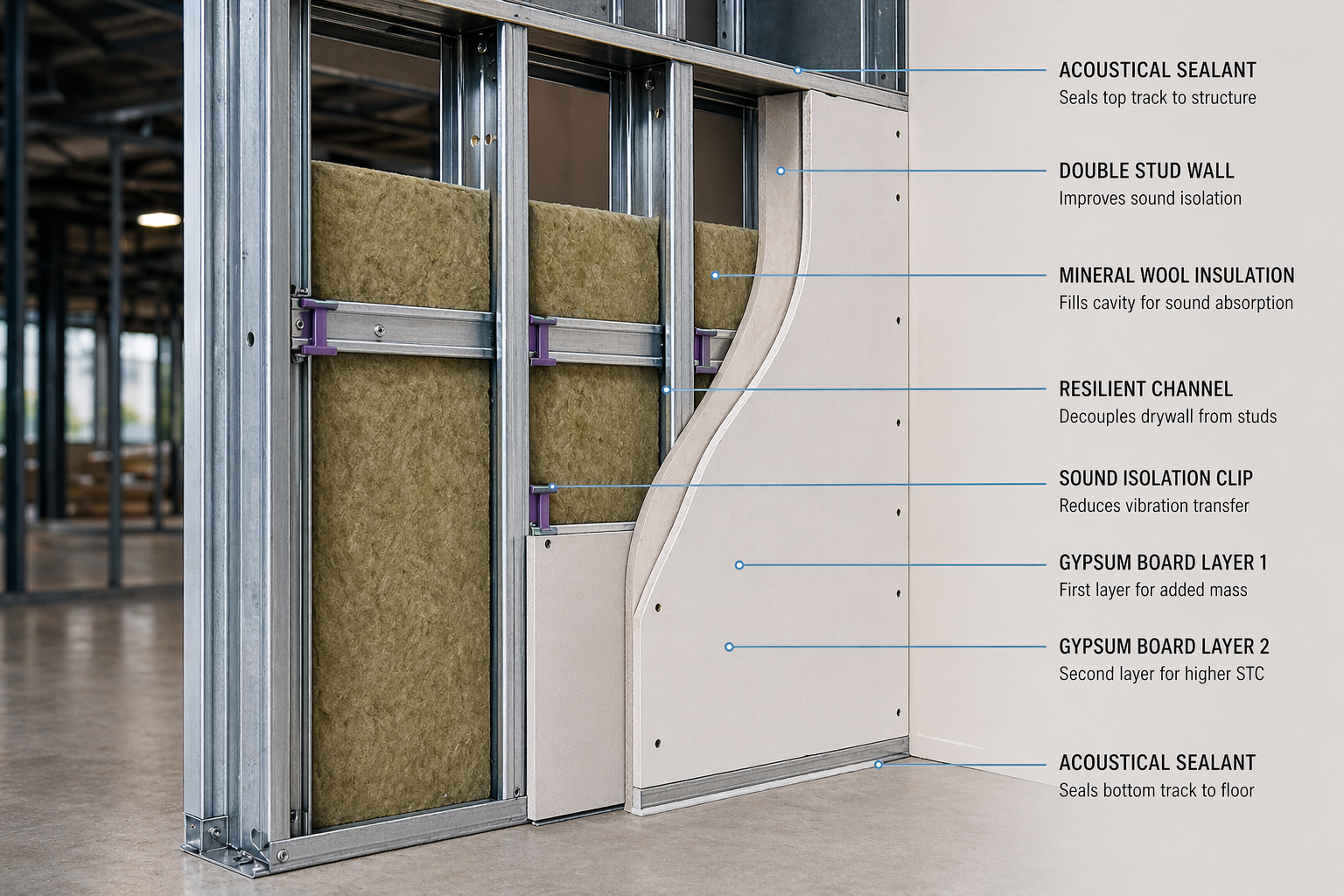
- Use of resilient channel or sound isolation clips
- Floor underlayment and finish flooring
- Ceiling suspension details
- Perimeter sealant continuity
- Penetration quantity and location
In real projects, redesigns often happen because one of these items changes late for structural, cost, MEP, or procurement reasons.
Cold-Formed Steel Acoustic Assemblies Are System Assemblies
A good rule of thumb is that acoustic performance in cold-formed steel should be treated as a system issue, not a single-product issue.
A wall with metal studs, batt insulation, and gypsum board may look adequate in plan. But the actual performance depends on whether the studs are shared or separated, whether the gypsum is directly attached or isolated, whether the cavity is fully filled, and whether the perimeter is sealed continuously.
The same is true for floors. A cold-formed steel floor assembly may rely on a combination of subfloor, underlayment, resilient ceiling treatment, insulation, and finish floor selection. Remove the underlayment, change the ceiling detail, or leave penetrations untreated, and the assembly may still look complete while performing much worse.
This is one reason sophisticated teams increasingly try to resolve these details early. The later the decision, the more likely acoustic intent gets diluted by other pressures.
Typical Assembly Strategies in Multifamily and Hotel Projects
There is no single universal solution, but most sound-rated cold-formed steel assemblies fall into a few common strategies.
For wall assemblies
Common approaches include:
- Insulated single-stud walls with multiple gypsum layers where moderate performance is acceptable
- Staggered or separated framing approaches where stronger decoupling is needed
- Shaft or service walls coordinated to limit flanking and penetration issues
- Corridor and unit separation walls with higher-performing board and insulation combinations
The higher the performance target, the more important decoupling and continuity usually become.
For floor-ceiling assemblies
Common strategies include:
- Structural floor system plus acoustical underlayment under finish flooring
- Insulated cavity below the floor structure
- Resiliently supported gypsum ceiling below
- Concrete or gypsum toppings in some systems to add mass and improve performance
- Careful perimeter and penetration treatment to control flanking paths
In hospitality work, hard flooring finishes often create additional pressure on the floor-ceiling design because impact sound becomes more noticeable.
The Most Overlooked Acoustic Problem: Flanking Paths
Many teams focus on the rated wall or floor itself and underestimate flanking.
Flanking is sound transmission that bypasses the main separating assembly. In other words, the wall may be rated correctly, but sound still finds another path around it.
Common examples include:
- Sound traveling through continuous structure
- Gaps at slab edge or head-of-wall conditions
- Poorly sealed partition intersections
- Back-to-back electrical boxes
- Continuous ceiling plenums
- Untreated duct, pipe, and conduit penetrations
- Floor finishes bridging intended isolation points
This is where execution quality matters. The drawing may identify a rated assembly, but the actual acoustic outcome often depends on the messy edges and intersections.
For that reason, sound-rated coordination should involve more than just the architect. Structural, MEP, drywall, flooring, and framing decisions all influence whether the assembly performs as intended.
Common Project Mistakes That Lead to Complaints or Rework
Acoustic failures are often not dramatic design errors. They are usually ordinary coordination misses that compound over time.
1. Treating tested assemblies as flexible templates
Teams may swap insulation, board thickness, or framing layouts for convenience without understanding the acoustic implications.
2. Ignoring penetrations until late
Acoustic performance is frequently weakened by unplanned device boxes, piping, ductwork, recessed accessories, and access panels.
3. Assuming floor finishes are interchangeable
Carpet, LVT, tile, and other hard finishes behave very differently acoustically. A floor-ceiling assembly that works with one finish may disappoint with another.
4. Overlooking head-of-wall and perimeter sealing
Small gaps matter. Even a strong wall assembly can underperform if the perimeter is not sealed continuously and correctly.
5. Failing to coordinate with panelization or prefabrication logic
If the building is using panelized cold-formed steel, the acoustic detail should be resolved before fabrication assumptions are locked in. Otherwise, field fixes can erode both performance and schedule benefits.
6. Missing flanking conditions at corridors and service zones
The rated partition may be fine, while sound bypasses it through adjacent assemblies or shared spaces.
Acoustic Coordination Is Also a Schedule Issue
Sound-rated assemblies are often discussed as a code or quality topic, but they are also a schedule topic.
Late acoustic redesigns can trigger a chain reaction. Framing details change. Board layers change. MEP routing changes. Ceiling depths shift. Floor buildup changes. Procurement needs to reorder materials. Shop drawings need revision. Installation sequencing becomes less clean.
That is why acoustic assemblies deserve early coordination in exactly the same way fire-rated, structural, and exterior envelope assemblies do. When the framing partner is brought in early, the team can align structural logic, manufacturability, wall thickness, floor buildup, and trade space before those decisions become expensive to revisit.
In cold-formed steel projects, that upstream clarity is especially valuable because the system performs best when it is resolved deliberately rather than adjusted in the field.
Practical Questions to Ask Early
The following questions tend to reveal risk before the project gets too far downstream:

When to Involve the Framing Partner
The framing partner should not be brought in only after the architectural assembly schedule is effectively fixed.
In sound-rated cold-formed steel projects, earlier involvement helps the team answer practical questions that affect both performance and execution:
- Can the selected wall and floor assemblies be manufactured and installed efficiently?
- Do the framing depths and layouts align with structural demands and acoustic intent?
- Are there transitions that will create downstream trade conflicts?
- Does the assembly logic support panelization without forcing field modifications?
- Have likely flanking conditions been identified before fabrication and installation planning?
That kind of involvement is not about selling complexity. It is about reducing it before the project reaches the field.
Final Takeaway
In multifamily and hotel projects, acoustic performance is one of the clearest examples of why assembly thinking matters.
Cold-formed steel can support highly consistent, well-performing sound-rated wall and floor systems, but only when the assembly is treated as a coordinated whole. Tested details matter. Penetrations matter. Intersections matter. Flooring choices matter. So does timing.
The teams that handle acoustics well usually do the same thing they do with other high-consequence building systems: they make key decisions earlier, coordinate across trades, and avoid treating field installation as the place where important assembly logic gets figured out.
That approach does not just improve sound control. It improves project control.
Related posts
SEE ALL POSTSSound-Rated Wall and Floor Assemblies for Cold-Formed Steel in Multifamily and Hotels

Exterior Wall Assemblies with Cold-Formed Steel: Sheathing, WRB, Insulation, and Cladding Coordination