
Fire-Rated Wall Assemblies for Cold-Formed Steel: What Developers, Architects, and GCs Need to Know
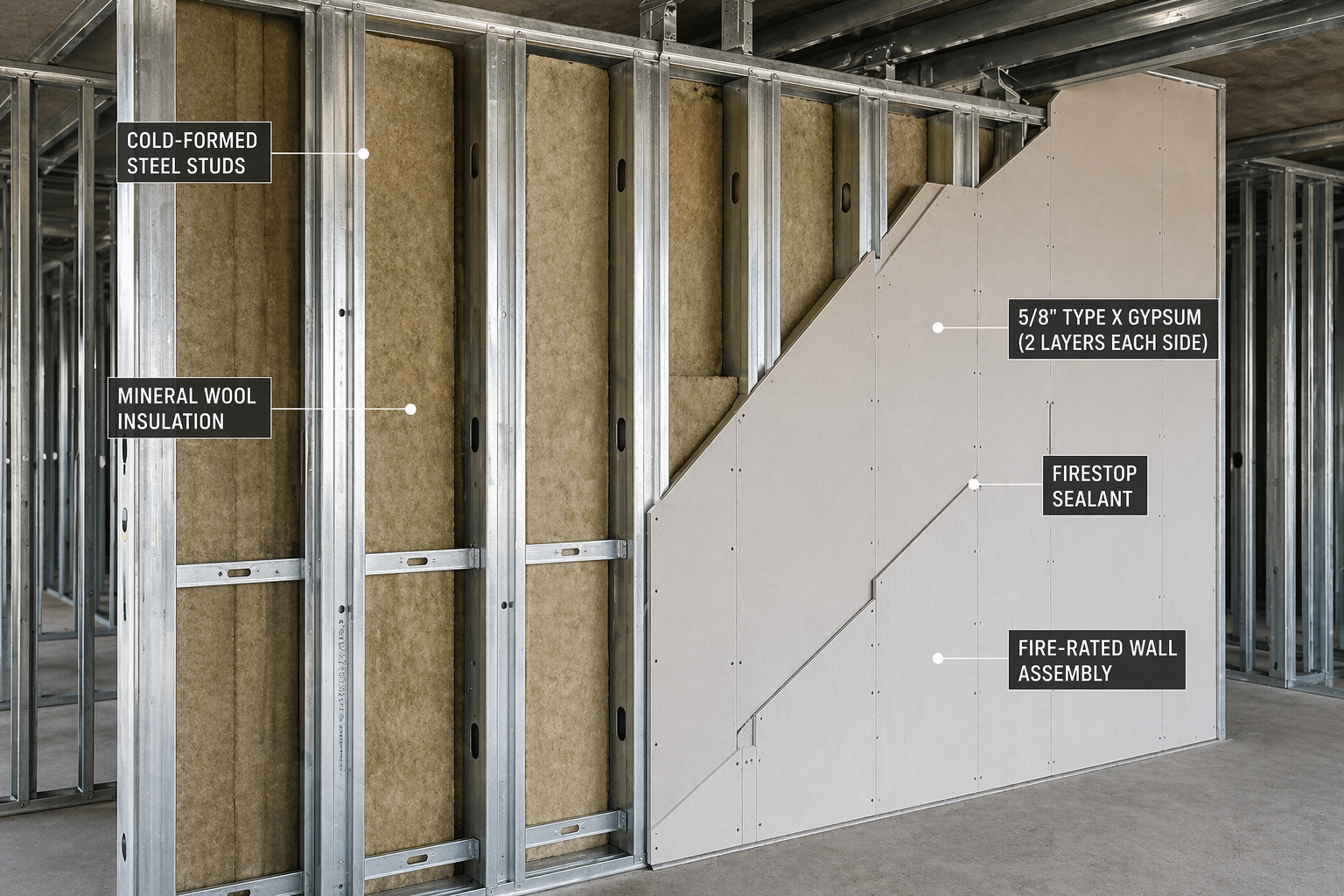
Fire-rated walls are rarely where teams want to spend time. But they are often where projects get slowed down.
On paper, a rated wall can look straightforward. In practice, it touches architecture, structural design, framing layout, gypsum scope, insulation, MEP routing, firestopping, inspections, and often the schedule. That is why fire-rated assemblies tend to create friction late in preconstruction or during field coordination.
For teams working in cold-formed steel framing, the goal is not simply to “have a rated wall.” The goal is to build a code-compliant assembly that matches a tested system, coordinates with the actual building design, and survives plan review and inspection without redesign. Fire-resistance ratings are assigned to assemblies as a whole, typically based on ASTM E119 or UL 263 testing, not to individual materials pulled from unrelated systems. UL also states that ratings apply to the assembly in its entirety and that components are not meant to be freely interchanged unless the published design permits it.
What a “fire-rated assembly” actually means
A fire-rated assembly is a tested wall, floor, roof, column, or other building element that has demonstrated the ability to resist fire for a defined period, such as 1 hour or 2 hours, under standardized test conditions. For wall assemblies, that evaluation generally looks at how long the wall resists fire exposure, limits heat transfer, and, where applicable, maintains structural performance. Wall tests also typically include a hose stream component.
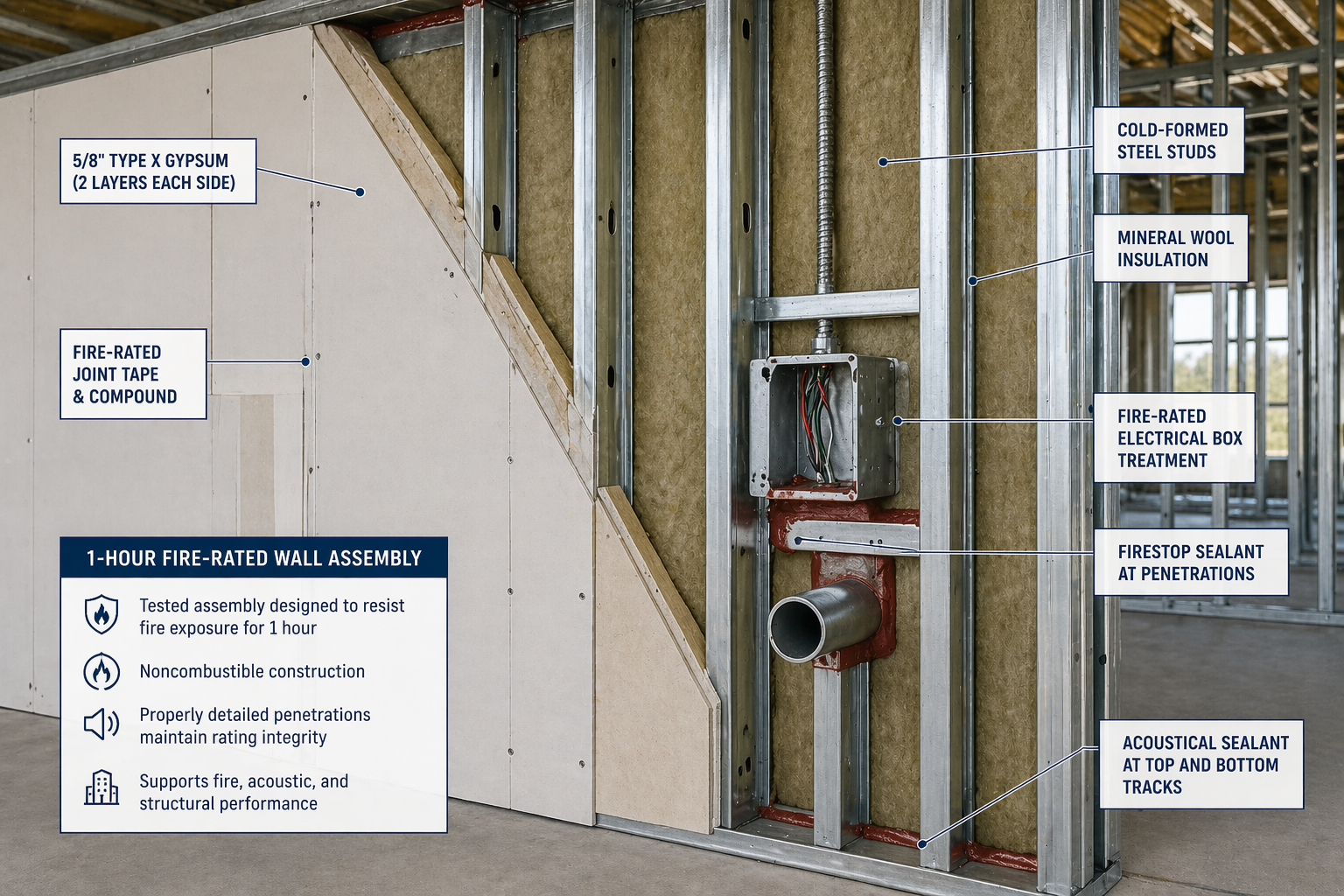
That distinction matters because many field problems come from treating the rating as if it belongs to one ingredient, such as “5/8-inch Type X gypsum” or “steel studs.” It does not. The rating belongs to the full listed or tested assembly: stud size and gauge, spacing, gypsum type and number of layers, insulation condition, fastener schedule, attachment method, and sometimes even details at joints or supports.
Cold-formed steel fits well into this world because it is noncombustible and widely used in tested fire-rated wall systems. But noncombustible does not mean automatically fire-rated. Steel framing is a strong platform for rated construction, yet the assembly still has to be selected, detailed, and built correctly.
1-hour vs 2-hour wall assemblies: what really changes
The difference between a 1-hour and a 2-hour wall is not just “one more layer of board.” In many systems, moving from 1 hour to 2 hours changes multiple variables at once: the number and type of gypsum layers, shaft liner conditions, stud depth or spacing, insulation requirements, and details at joints and penetrations. Published design manuals and listed systems show that these ratings are achieved through specific combinations, not rules of thumb.
From a project standpoint:
1-hour walls
These are common where the code requires a lower level of separation, such as many dwelling-unit separations, corridor walls, and some tenant or occupancy separations depending on the building type, sprinkler condition, and use.
2-hour walls
These are more common where the consequence of failure is higher or where the code requires a more robust separation, such as many shaft enclosures, certain occupancy separations, and some exterior wall conditions or structural support conditions tied to the broader fire-resistance strategy.
The practical implication is simple: a 2-hour wall usually carries more cost, more material, more coordination sensitivity, and less tolerance for improvisation.
Common use cases in real projects
Unit demising walls
In multifamily and hospitality work, these walls are often part of the life-safety and acoustical strategy at the same time. Many are designed as fire partitions or other rated separations depending on occupancy and code path. The mistake is assuming the wall can be value-engineered in isolation without affecting acoustics, structure, and MEP routing.
Corridor walls
Corridor walls are commonly required as fire partitions in means-of-egress systems, though exact requirements vary by occupancy, sprinklering, and local code adoption. They often look simple but become complicated when teams start pushing soffits, access panels, duct crossings, and late device locations into them.
Shaft walls
Shaft walls are usually less forgiving. Shaft enclosures are generally built as fire barriers and require continuity and support conditions that have to be resolved early. These assemblies are often where teams discover too late that a generic wall detail is not enough.
Exterior walls in certain conditions
Exterior walls can require fire-resistance ratings based on occupancy, construction type, fire separation distance, and other code triggers. This is where project-specific analysis becomes critical. The wall may also need to coordinate sheathing, weather barrier, insulation, cladding attachment, and structural demands without drifting from the tested assembly basis.
How cold-formed steel fits fire-conscious and noncombustible designs
Cold-formed steel is attractive in projects where fire performance matters because the framing itself is noncombustible and does not add fuel load the way combustible framing does. That makes it a logical fit for developers and design teams pursuing more resilient assemblies, more demanding construction types, or a more conservative life-safety posture.
But the steel does not solve everything by itself. Under high temperatures, steel can lose strength and stiffness, which is exactly why the tested wall build-up matters. In other words, the advantage is real, but it only translates into performance when the full assembly is properly selected and installed.
What is project-specific vs what comes from tested assemblies
This is where many teams get mixed up.
What usually comes from the tested or listed assembly
Stud size and spacing, board type and number of layers, insulation condition where required, fastener patterns, and overall construction sequence often come directly from the published system. Those are not casual choices.
What is project-specific
Code-required rating by location, wall classification, structural loading, deflection criteria, top-of-wall conditions, support of the assembly, head-of-wall joint treatment, opening protection, penetration protection, acoustics, thermal performance, and how the wall interfaces with the rest of the building are project-specific issues. Supporting construction can also matter; a rated wall is not effective if the supporting condition fails earlier than the wall strategy assumes.
That is why “we found a UL wall” is not the same as “the wall is resolved.”
Coordination: where rated walls either hold up or fall apart
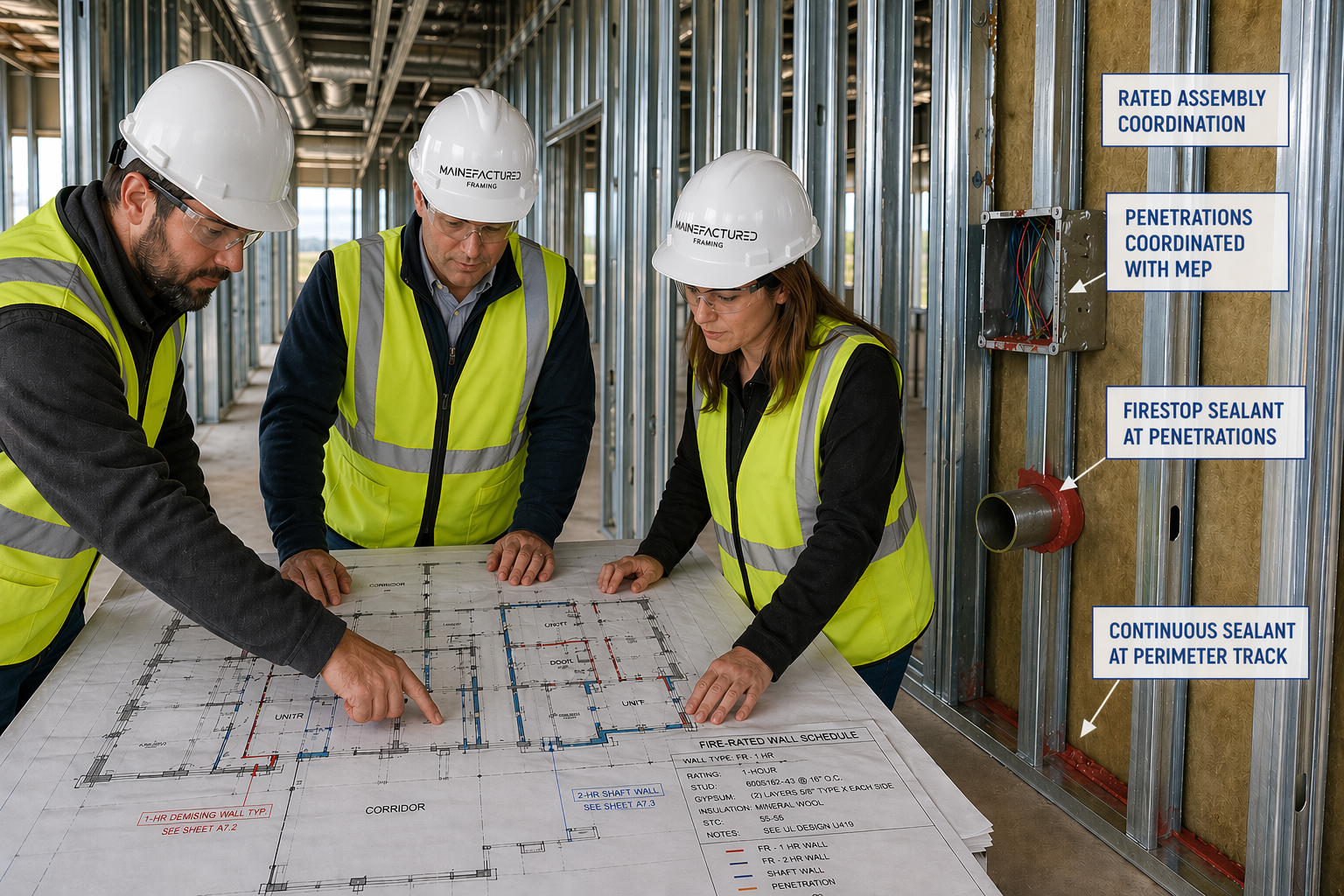
The cleanest rated-wall packages are coordinated before fabrication, not after framing starts.
The key items to align early are:
- stud depth, gauge, and spacing
- gypsum type and exact layer count on each side
- mineral wool or other insulation requirements
- top and bottom track conditions
- shaft wall sequence where applicable
- penetrations by trade
- outlet boxes, access panels, and sleeves
- head-of-wall and perimeter joint systems
- firestopping responsibilities between trades
The biggest risk is usually not the main wall section. It is the exceptions: a duct that got larger, a back-to-back box location, a shaft door revision, an unplanned access panel, or a top-of-wall condition that no longer matches the listed approach.
Common mistakes that trigger redesigns or inspection issues
One of the most common mistakes is mixing components from different assemblies because they look similar. Another is assuming a rated wall detail is complete without resolving penetrations, joints, or support conditions. UL’s guidance is explicit that assemblies must be built as specified unless the listing allows an alternate.
Other frequent problems include:
- changing stud spacing or gauge without checking the assembly basis
- missing a required layer of board in the field
- moving MEP penetrations after permit without rechecking the detail
- using the wrong box treatment in rated partitions
- overlooking continuity requirements at shafts and barriers
- treating acoustical insulation and fire insulation as interchangeable without verifying the listed design
- waiting too long to assign who owns firestopping and special conditions
These are rarely dramatic errors at first. They usually surface as plan comments, rejected submittals, failed inspections, or expensive field fixes.
When to involve the framing partner early
The right time is before the rated walls are fully baked into CDs without constructability input.
A framing partner should be involved early when:
- the project has multiple wall types with mixed rating requirements
- shafts and corridor walls drive the layout
- exterior wall ratings interact with envelope design
- the team is converting from wood or another system to cold-formed steel
- MEP density is high
- schedule certainty matters enough that field redesign is unacceptable
In those situations, early input helps the team choose assemblies that are not only code-compliant on paper, but also repeatable, fabricatable, and easier to inspect. That is especially valuable in panelized work, where upstream decisions reduce downstream ambiguity.
FAQ
Does cold-formed steel automatically make a wall fire-rated?
No. Steel is noncombustible, but the fire rating belongs to the tested assembly, not the framing material alone.
Is a 2-hour wall always just a thicker version of a 1-hour wall?
No. It often involves a different listed assembly with multiple changed variables, not just one added layer of gypsum.
Can we swap gypsum brands or insulation types freely?
Only where the listed system, code path, or approved substitution permits it. Many assembly components are not intended to be mixed casually.
Are penetrations allowed in rated walls?
Yes, but they must be handled in accordance with the applicable protection requirements and the project’s tested or approved strategy.
Do shaft walls deserve special attention?
Yes. Shaft enclosures are commonly built as fire barriers and require early coordination for continuity, support, openings, and penetrations.
What usually causes trouble during inspection?
Unapproved field changes, missing layers, uncoordinated penetrations, incorrect joint treatment, and details that do not match the basis-of-design assembly.
The bottom line
Fire-rated wall assemblies are not just a product selection exercise. They are a coordination exercise.
For developers, architects, and GCs using cold-formed steel, the advantage is not only that steel fits well within noncombustible and fire-conscious construction. The bigger advantage is that a disciplined system can be resolved early, detailed clearly, and repeated with less field uncertainty.
That is what keeps rated walls from becoming late-project surprises.
Related posts
SEE ALL POSTS
Sound-Rated Wall and Floor Assemblies for Cold-Formed Steel in Multifamily and Hotels

Exterior Wall Assemblies with Cold-Formed Steel: Sheathing, WRB, Insulation, and Cladding Coordination