Exterior Wall Assemblies with Cold-Formed Steel: Sheathing, WRB, Insulation, and Cladding Coordination

Exterior wall problems rarely start with cladding.
They usually start earlier, when the wall is still being treated as a stack of separate scopes instead of one integrated assembly. The framing team is thinking about stud layout and load paths. The architect is focused on aesthetics and envelope performance. The waterproofing consultant is focused on continuity. The insulation scope gets priced separately. The cladding installer assumes the substrate will be ready. Then the project reaches the field and everyone discovers that the tolerances, fastening, sequencing, and transitions were never fully resolved.
That is where exterior wall assemblies become expensive.
With cold-formed steel framing, this coordination matters even more because the system is precise. That precision is an advantage, but it also exposes weak detailing decisions faster. If the team has not aligned sheathing type, WRB approach, insulation strategy, attachment requirements, and cladding support conditions early, the wall can become a source of RFIs, redesigns, and downstream trade friction.
For developers, architects, and GCs, the real issue is not whether each component works on its own. It is whether the full assembly can be installed in a clean sequence, inspected without confusion, and handed off to the next trade without field improvisation.
Why Exterior Wall Assemblies Need Early Coordination
Exterior walls are where structure, moisture control, thermal performance, air control, aesthetics, and installation logistics all collide.
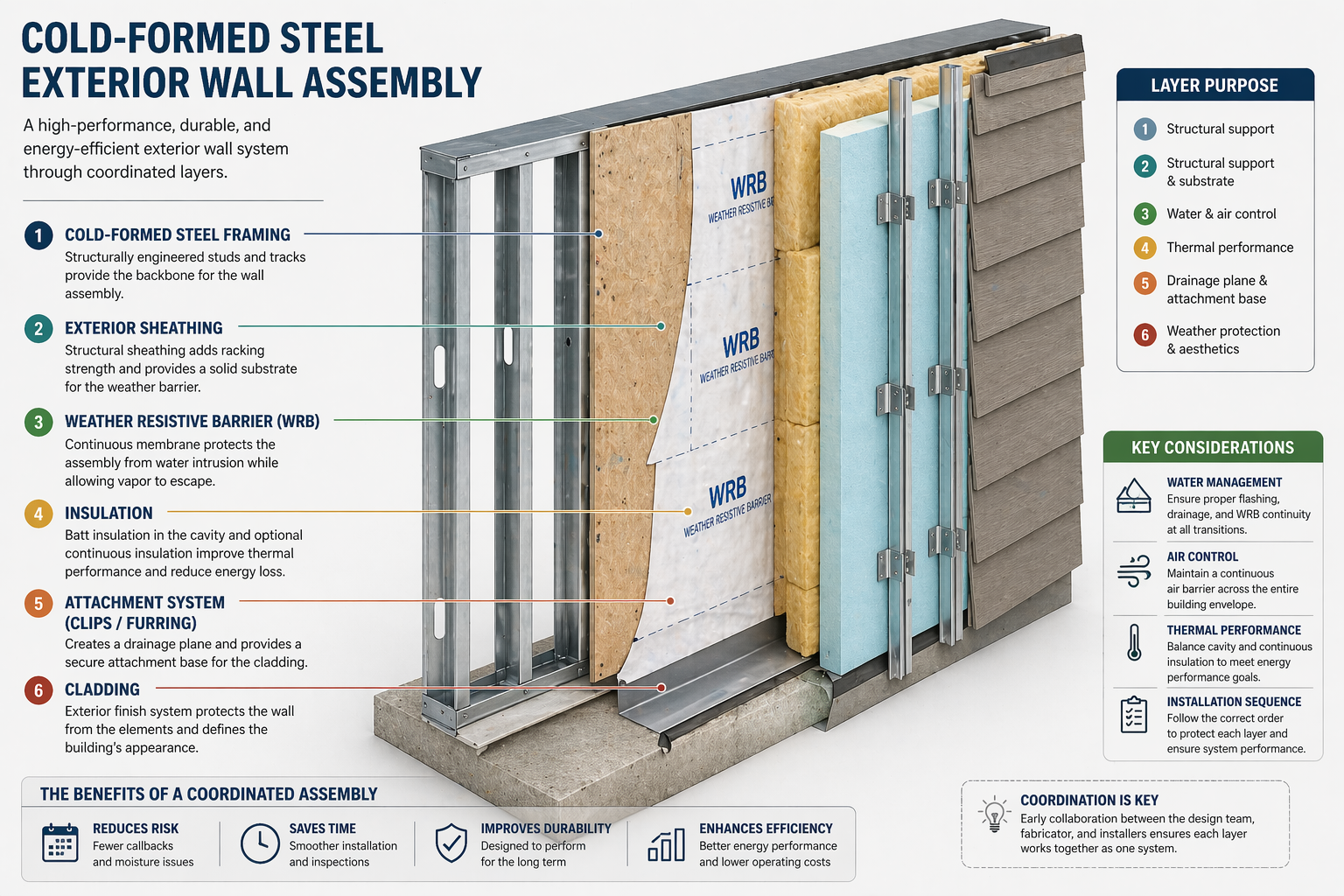
A cold-formed steel exterior wall may involve:
- structural studs and tracks
- exterior sheathing
- a WRB or air barrier strategy
- cavity insulation, continuous insulation, or both
- attachment rails, clips, or furring
- windows and flashing interfaces
- cladding systems with different weight and movement characteristics
Each of those decisions affects another one.
For example, changing the cladding from lap siding to brick veneer or metal panels is not just a finish upgrade. It can change fastening loads, backup requirements, tolerances, support conditions, and sequencing. Likewise, switching from batt-only insulation to continuous exterior insulation affects WRB location, attachment detailing, window returns, and the depth of penetrations.
The mistake many teams make is treating these as submittal-stage issues. By then, the framing package may already be engineered, the panel layouts may already be moving, and changes start getting absorbed through field workarounds.
The better approach is to resolve the exterior wall as a system before production and procurement lock in too many assumptions.
Start with the Wall’s Job, Not the Product List
A coordinated exterior wall assembly starts with a simple question:
What does this wall need to do on this project?
That sounds obvious, but many teams jump directly to products before they have aligned the wall’s priorities. In real projects, exterior walls are usually balancing five things at once:
1. Structural support
The wall has to carry its own loads, transfer lateral forces appropriately, and provide a suitable substrate or backup for the selected exterior finish.
2. Moisture management
Bulk water, drainage, flashing, and transition detailing must be clear. The wall needs a consistent strategy, not a collection of disconnected details.
3. Air control
The building needs a defined air-control layer and a realistic plan for continuity at transitions, penetrations, windows, floor lines, parapets, and roof connections.
4. Thermal performance
Insulation decisions affect energy performance, condensation risk, wall thickness, attachment depth, and detailing around openings.
5. Constructability
The wall has to be buildable in the actual project sequence, with realistic tolerances and clean handoffs between trades.
When those priorities are explicit early, material selection gets easier. When they are not, the project tends to accumulate incompatible assumptions.
Sheathing: More Than a Substrate
In many projects, sheathing gets treated as a commodity. It is not.
Sheathing affects structural bracing, moisture exposure tolerance, substrate flatness, fastener holding conditions, and compatibility with the WRB and cladding strategy. On cold-formed steel walls, it also plays a major role in how cleanly the wall can be panelized, staged, and handed off in the field.
The key questions are:
- Is the sheathing primarily structural, environmental, or both?
- Will it be installed in the plant, in the field, or partially in each location?
- Does the selected cladding require a flatter or more rigid substrate?
- How long might the assembly be exposed before the full weather barrier and cladding are complete?
On paper, many sheathing options can work. In practice, the right choice depends on what the rest of the wall needs from it.
For developers and GCs, the bigger lesson is that sheathing should not be selected in isolation from the envelope sequence. A cheaper board choice can become expensive if it creates rework, exposure issues, or poor handoff conditions for the WRB and cladding installers.
WRB: The Details Matter More Than the Label
Teams often talk about WRB selection as if it is mostly a product decision. It is usually a detailing and coordination decision.
A WRB can look fully resolved in specifications and still fail the project in execution if transitions are vague. The vulnerable locations are predictable:
- window and door openings
- base-of-wall conditions
- shelf angles and floor-line transitions
- penetrations by MEP trades
- roof-to-wall intersections
- parapets and coping interfaces
- movement joints and dissimilar material transitions
The biggest coordination mistake is assuming the WRB trade will “figure it out in the field.” That is exactly how continuity breaks happen.
On cold-formed steel projects, especially panelized ones, the team should decide early where the WRB is being established, who is responsible for each transition, and what conditions must exist before the next trade starts. If part of the wall is preassembled and part is field-finished, those interfaces need to be especially clear.
A good exterior wall detail does not just show where the WRB goes. It shows where responsibility changes.
Insulation Strategy Changes the Entire Wall
Insulation decisions are rarely neutral.
Cavity insulation, continuous insulation, hybrid assemblies, and rainscreen approaches all affect wall thickness, attachment strategy, sequencing, and opening details. The team may begin by thinking only about code compliance or thermal targets, but the implications go much further.
For example, adding exterior continuous insulation may improve overall thermal performance, but it also raises practical questions:
- How is cladding being attached through the insulation?
- What happens to window depth and flashing returns?
- Are attachment clips, rails, or furring part of the frame design, envelope scope, or cladding scope?
- What does that do to tolerance stacking?
Those are not minor details. They shape how the wall gets priced and built.
With cold-formed steel framing, the smart move is to evaluate insulation strategy alongside attachment strategy, not after it. Otherwise, teams end up redesigning support conditions late or creating site-built fixes that undercut the original intent of a more controlled wall system.
Cladding Coordination Is Where Late Problems Show Up
Cladding is usually where assembly problems finally become visible.
By the time the facade installer arrives, the wall may already be carrying hidden coordination debt: uneven substrate conditions, unclear fastening zones, poorly resolved openings, misaligned thicknesses, or missing transition details. The cladding crew does not create those problems. They expose them.
Different claddings place different demands on the wall:
The point is not that one cladding is easier than another. The point is that each one changes the coordination burden.
Teams that wait to think seriously about cladding support until after framing is released are setting themselves up for friction.
Common Failure Points in CFS Exterior Walls
Most exterior wall issues are not caused by one catastrophic mistake. They come from smaller coordination gaps that compound.
The most common ones include:
Unclear scope boundaries
No one has clearly assigned who owns transitions, blocking, attachment accessories, or opening preparation.
Window details developed too late
The project has a generic wall section, but no buildable plan for rough openings, flashing sequence, insulation returns, and cladding terminations.
Cladding loads not reconciled early
The wall was engineered before the support requirements for the final facade were fully understood.
Tolerance assumptions that do not survive the field
Each trade assumes the next one can absorb variation.
Panelization decisions made without envelope input
The framing package moves ahead, but the sheathing, WRB, and cladding interfaces are not aligned with fabrication and installation sequencing.
What Good Coordination Looks Like
The best exterior wall assemblies are not necessarily the most complex or expensive. They are the ones that are resolved early enough to be repeatable.
That usually means:
- the architect, framing partner, and envelope team align on a few standard wall types early
- opening details are treated as critical path decisions, not drafting cleanup
- the insulation strategy is reviewed together with attachment and cladding support
- responsibility for WRB transitions and penetrations is clearly assigned
- the team pressure-tests the actual installation sequence before the project hits the field
For developers, this reduces change noise and protects schedule. For architects, it preserves design intent without forcing late compromises. For GCs, it creates cleaner procurement, fewer coordination calls, and more predictable inspections.
That is the real value of early wall assembly coordination. It is not just technical correctness. It is project calm.
Conclusion
Exterior wall assemblies with cold-formed steel are not won by picking good products. They are won by making sure the products, details, and sequence actually work together.
Sheathing, WRB, insulation, and cladding are often bid as separate scopes, but the building does not experience them separately. Neither does the schedule.
When teams coordinate the exterior wall early, cold-formed steel becomes an advantage because it supports precision, repeatability, and cleaner downstream execution. When they do not, the wall becomes one more place where uncertainty gets pushed into the field.
And in most projects, that is where costs rise fastest.
Related posts
SEE ALL POSTS
Sound-Rated Wall and Floor Assemblies for Cold-Formed Steel in Multifamily and Hotels
Exterior Wall Assemblies with Cold-Formed Steel: Sheathing, WRB, Insulation, and Cladding Coordination