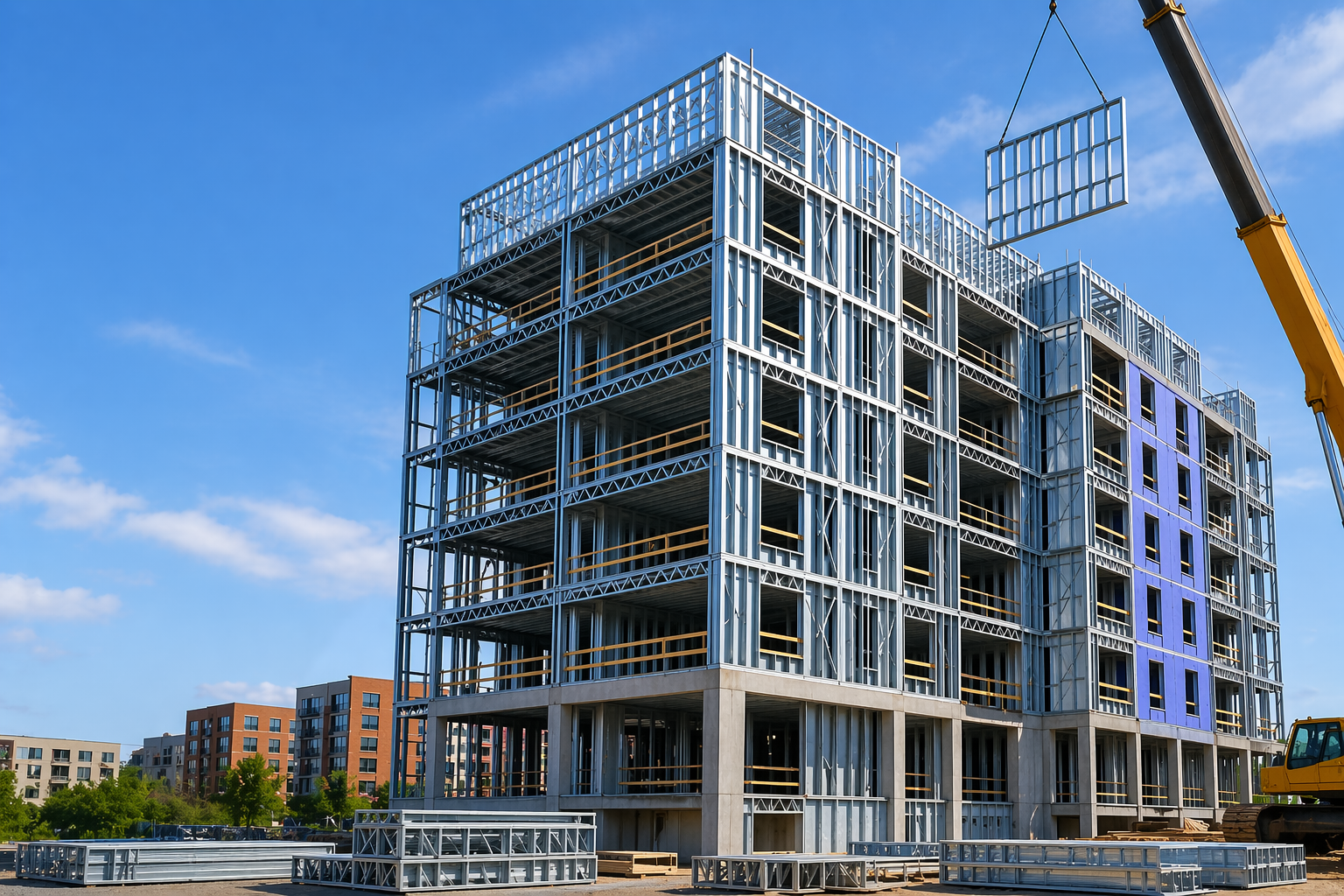
Scaling Multifamily Construction with Panelized Metal Framing
Multifamily projects don’t usually fail because the design is impossible.
They fail because the same predictable problems keep showing up at scale: labor variability, sequencing friction, rework, inspection churn, and schedule drift that compounds across buildings and phases.
That’s the hard part about “scaling” multifamily. Your business model depends on repetition, but traditional framing workflows introduce new randomness every day. The more buildings you start, the more exposed you become to field variability.
Panelized metal framing is one of the few structural scopes that can actually become more reliable as you scale, because it changes when decisions get made and where variability is allowed to exist.
This isn’t a pitch for “offsite everything.” Modular has its place. Stick framing has its place. But if your goal is to deliver repeatable multifamily buildings with tighter cycle times and fewer field surprises, panelized metal framing is worth evaluating as a scaling mechanism, not just a material substitution.
Why scaling multifamily breaks traditional framing assumptions
When teams talk about scaling, they often focus on procurement volume and headcount.
But the real constraint is execution consistency: can you produce the same assemblies, in the same sequence, with the same tolerances, building after building?
Traditional site-built framing struggles here for a few structural reasons:
The jobsite is a moving target
Crew composition changes. Weather changes. Staging space changes. Trade stacking changes. Even when the drawings don’t change, execution does.
Decisions get made too late
A lot of “framing decisions” aren’t actually resolved in design. They get resolved in the field—at openings, transitions, deflection conditions, MEP penetrations, rated assemblies, and interface details. Late decisions create RFIs, workarounds, and downstream trade friction.
Repetition can amplify defects
If you repeat a building three times, small inconsistencies become systemic problems: door frames don’t fit the same, cabinet lines change, corridor walls wander, rated details get interpreted differently, and inspection outcomes vary depending on which inspector shows up.
Scaling with a workflow that depends on “good crews having a good week” is fragile.
What panelized metal framing actually changes (and why it scales)
Panelized metal framing is not simply “prefab studs.” The scaling advantage comes from upstream resolution and controlled repetition:
1) The model becomes the jobsite
Instead of discovering clashes and ambiguity on the slab, you’re forcing coordination earlier—before fabrication and before installation starts dictating the pace.
2) Variability is engineered out
Panelization rewards standardization: repeatable wall types, consistent openings, consistent deflection strategies, consistent load paths, consistent attachments. When you standardize, the system gets faster and less error-prone.
3) Labor becomes more predictable
Field framing is a labor availability problem. Panelization turns part of that problem into a production problem. That shift matters when you’re trying to start buildings on cadence.
4) Installation becomes a sequence, not a craft project
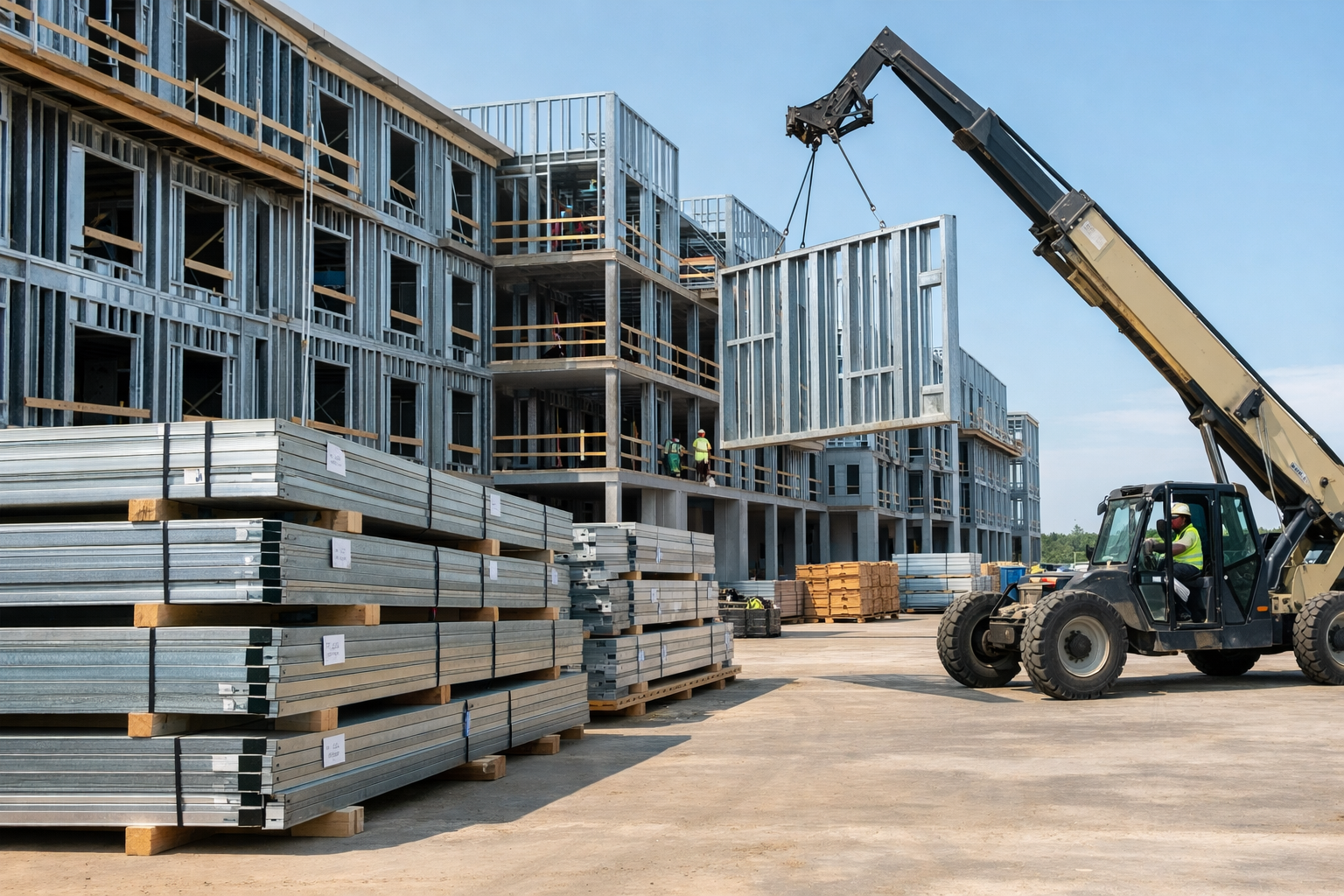
A panel package can be delivered in a planned set order, staged to match floors and zones, and installed with a defined pick plan. That’s the difference between “framing on site” and “assembly on site.”
The multifamily scaling bottlenecks panelization helps relieve
Schedule reliability and cycle time
Multifamily schedules rarely collapse from one big event. They collapse from 50 small misses: missed inspections, missing material, out-of-plumb corrections, trade stacking conflicts, and rework caused by inconsistent framing.
Panelized metal framing improves schedule reliability by:
- Reducing on-site cutting and sorting
- Tightening sequencing (staged panels, planned picks)
- Making inspection outcomes more repeatable (consistent assemblies)
- Reducing downstream fit-up surprises (straighter walls, consistent openings)
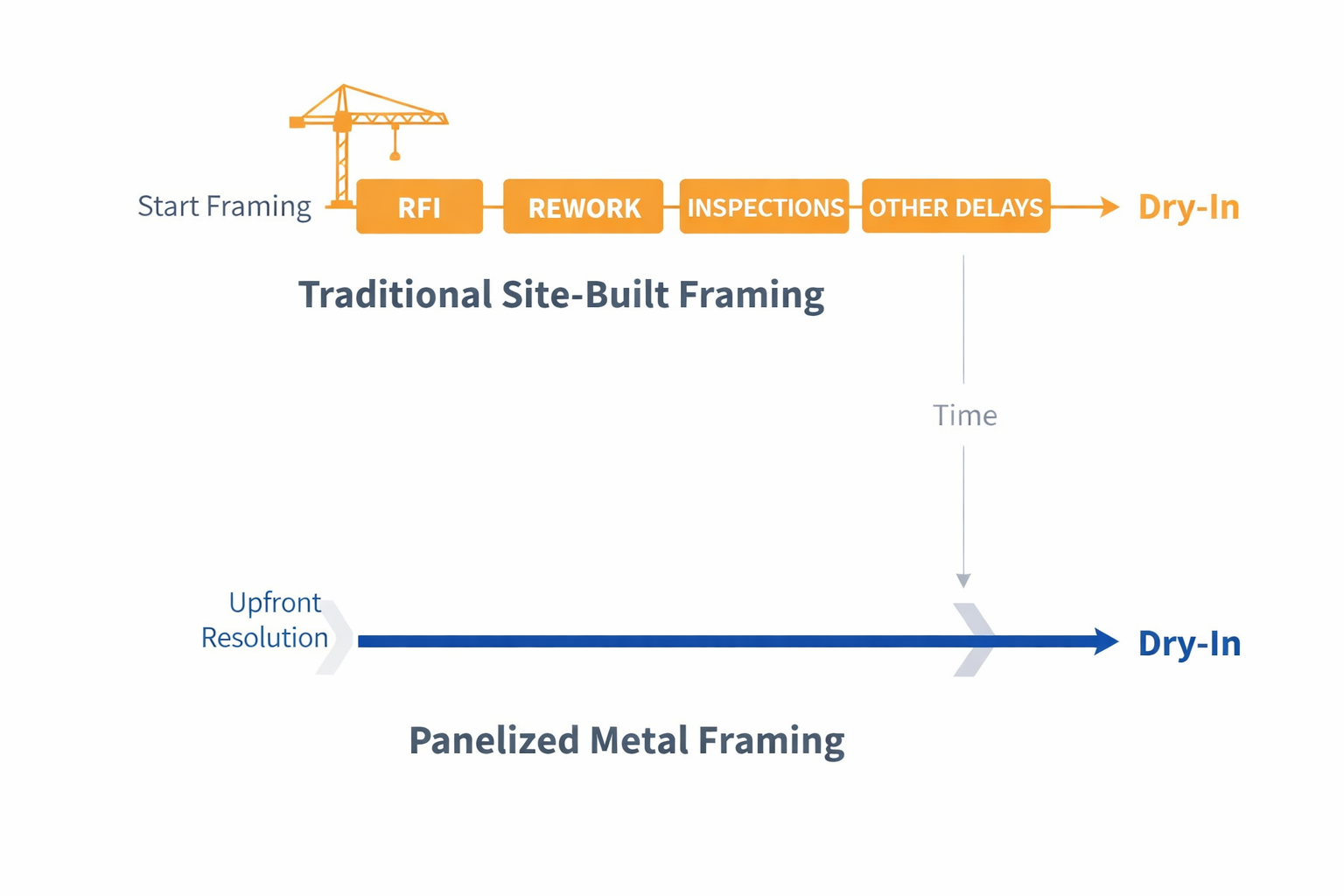
What this looks like in practice: better dry-in predictability, fewer “lost days” between trades, and smoother floor-to-floor cadence.
Quality control that actually scales
Quality in multifamily is not just about straight walls. It’s about fewer downstream constraints:
- Door and hardware alignment
- Cabinet and millwork fit
- Tile layouts and wet wall consistency
- Rated wall continuity and documentation
- Corridor straightness (the place where drift becomes very visible)
Panelized systems allow you to enforce repeatable assemblies and tolerances before the wall is standing in the building.
Change management discipline
In scaled multifamily, late changes are expensive because they ripple across:
- Shop drawings
- Fabrication packages
- Installation sequencing
- MEP rough-in coordination
- Inspections and firestopping scopes
Panelization doesn’t eliminate changes. It changes the cost of late change, which forces healthier project discipline. That’s a feature, not a bug—if your goal is predictable delivery.
Jobsite logistics and congestion
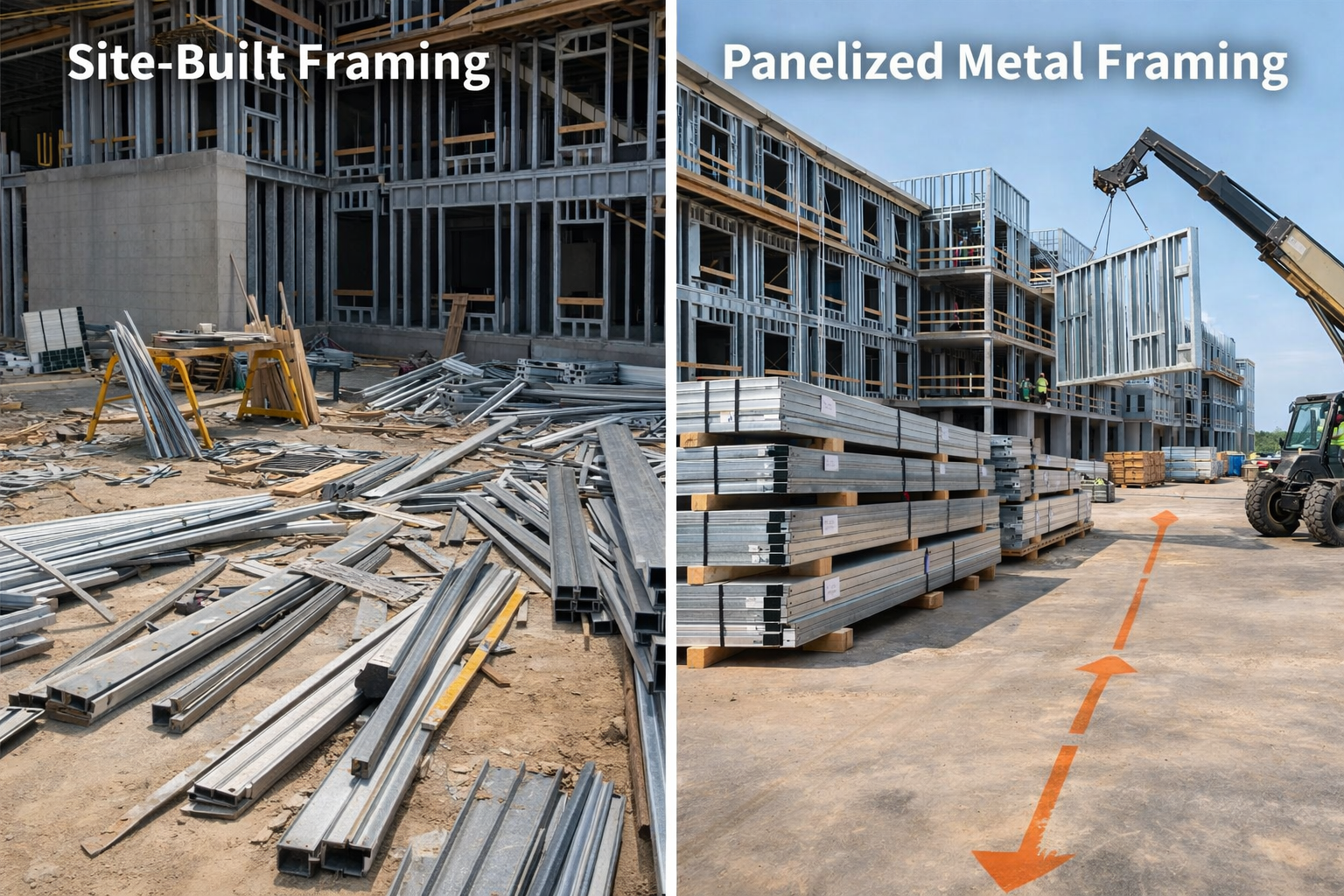
Multifamily sites are staging-constrained. Material chaos steals time, creates safety risk, and increases damage and waste.
Panelization can reduce:
- Loose material piles
- On-site fabrication footprints
- Re-handling and double-touch labor
- Trade interference
This matters most in urban and infill sites, podium projects, and any site where laydown is limited.
Where panelized metal framing fits best in multifamily
Panelization scales best when the project has repeatable geometry and repeatable wall types—exactly what many multifamily buildings already have.
Strong-fit conditions include:
- Repetitive unit stacks and corridor walls
- Consistent window and door patterns
- High proportion of interior partitions and shear walls
- Multiple buildings or phases with the same prototype
- Tight schedule requirements (lease-up windows, lender milestones)
It can also work in more complex buildings, but the value comes from disciplined scope definition and early coordination.
The honest trade-offs (what sophisticated teams should pressure-test)
Scaling with panelized metal framing is not “free time.” You are trading certain frictions for others.
Trade-off 1: You shift effort earlier
You will spend more time upfront in:
- Wall type standardization
- Coordination and clash resolution
- Shop drawing review cycles
- Staging and pick planning
- Procurement alignment (connectors, tracks, attachments)
If your team treats preconstruction as optional, panelization will feel painful.
Trade-off 2: Design ambiguity gets exposed
Panelization forces resolution. If your drawings are incomplete or your details are inconsistent, the system will surface it immediately—through RFIs and clarification needs.
That’s not a disadvantage. It’s cost transparency. But it can be uncomfortable if a team is used to “figuring it out in the field.”
Trade-off 3: You need installation sequencing discipline
Panels don’t like chaotic sites. If access is blocked, picks are unplanned, or crews aren’t aligned with the install sequence, you can lose the benefits quickly.
The best outcomes happen when panelization is treated as a logistics-driven scope as much as a framing scope.
Trade-off 4: Not everything should be panelized
Trying to panelize every last condition can be counterproductive. Successful multifamily packages typically include a mix:
- Highly repetitive walls panelized
- Complex transition zones field-framed with clear details
- A defined strategy for MEP penetrations and coordination
Decision table: what changes when you scale with panelization
How to evaluate panelized metal framing for your next multifamily project
If you want a decision-grade evaluation (not a brochure comparison), focus on these five questions:
1) Where does schedule slip today—really?
Don’t just say “framing is slow.” Identify the real failure modes:
- Inspection delays?
- Crew variability?
- Rework at openings?
- Corridor alignment and downstream finishes?
- MEP conflicts and late RFIs?
Panelization helps most when your schedule slip is caused by variability, not just production rate.
2) How repeatable is your prototype?
If you’re building multiple buildings, your prototype discipline is everything. Panelization rewards teams that lock:
- Wall types
- Opening standards
- Rated details
- Deflection strategies
- Interface conditions at structure and slabs
If the prototype won’t stay locked, the compounding benefits won’t show up.
3) Are you willing to move decisions upstream?
Panelization compresses the “decision window.” If your culture depends on late decisions, you’ll feel constrained. But if you want scale, discipline is usually the path.
4) Do you have a real staging and pick plan?
Panelization isn’t just a fabrication question. It’s a site logistics question:
- Where do panels land?
- In what order?
- Who controls crane/telehandler time?
- How do you avoid double-handling?
This is where many projects win or lose the benefit.
5) Are you optimizing for cost, or for cost certainty?
The most important scaling metric isn’t “cheapest framing number.” It’s:
- predictable cycle time
- fewer change events
- fewer downstream corrections
- less schedule-driven premium labor
- more reliable close-out
That’s how scaled delivery protects returns.
Conclusion: scaling needs repeatability more than speed
If you’re trying to scale multifamily, you’re not just building buildings.
You’re building a repeatable delivery machine.
Panelized metal framing supports that goal because it reduces the part of framing that depends on daily jobsite improvisation. It rewards prototype discipline, forces coordination earlier, improves repeatability, and makes field installation more sequence-driven.
It also comes with real trade-offs: more upfront resolution, tighter change control, and a higher expectation of logistics planning.
But that’s exactly what scaled construction requires anyway.
In other words: panelization isn’t a shortcut. It’s an operating model.
Related posts
SEE ALL POSTS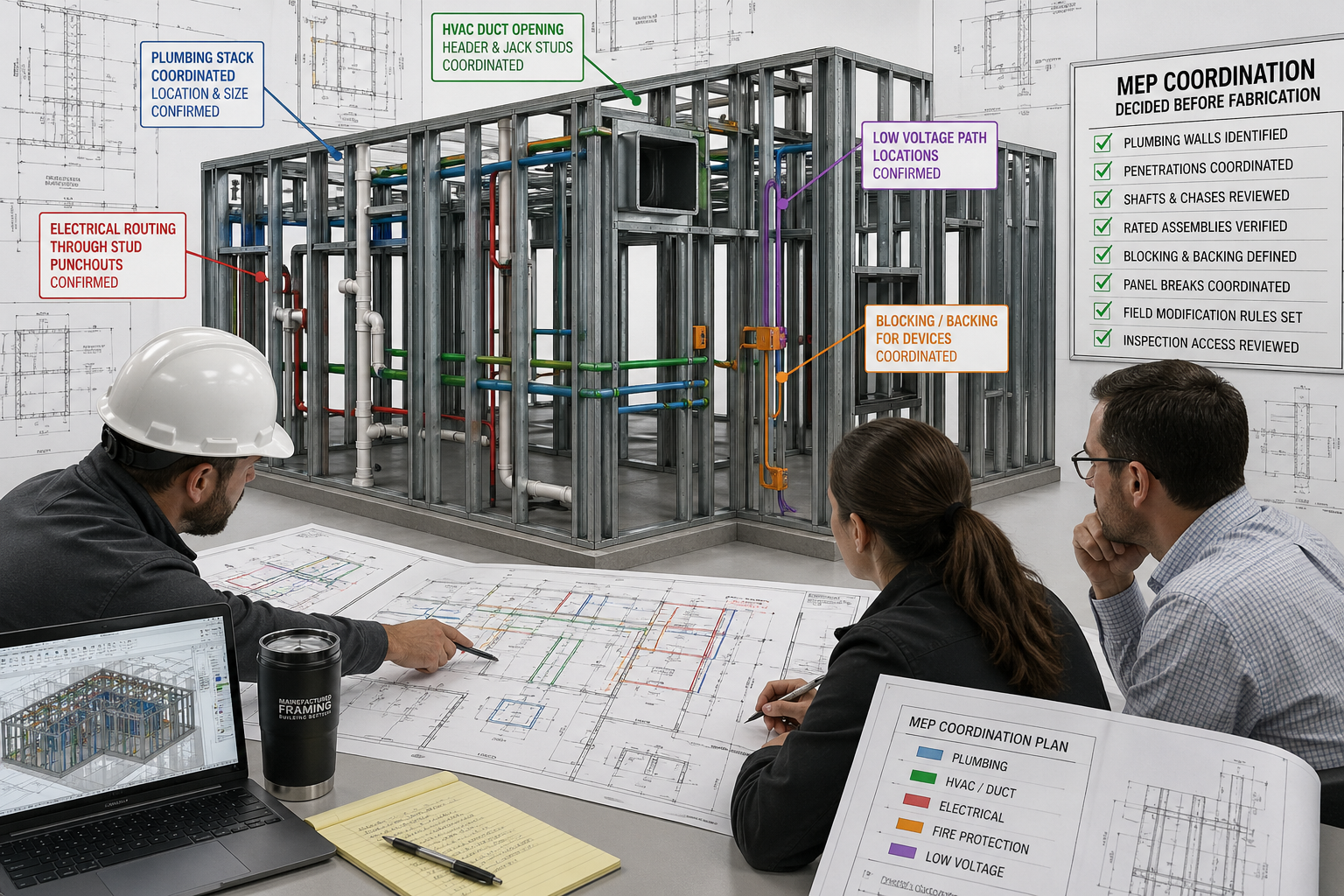
MEP Coordination in Panelized Cold-Formed Steel: What Must Be Decided Before Fabrication
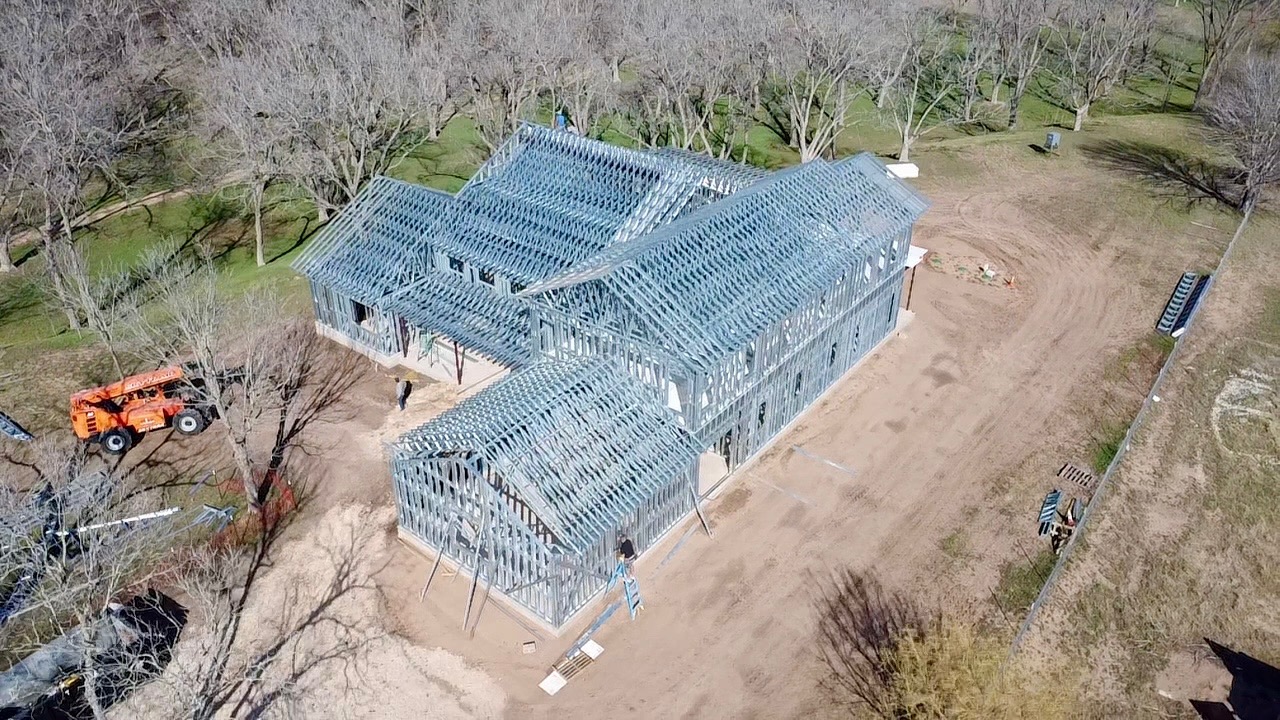
Cold-Formed Steel for Custom Homes: What High-End Builders Need to Know