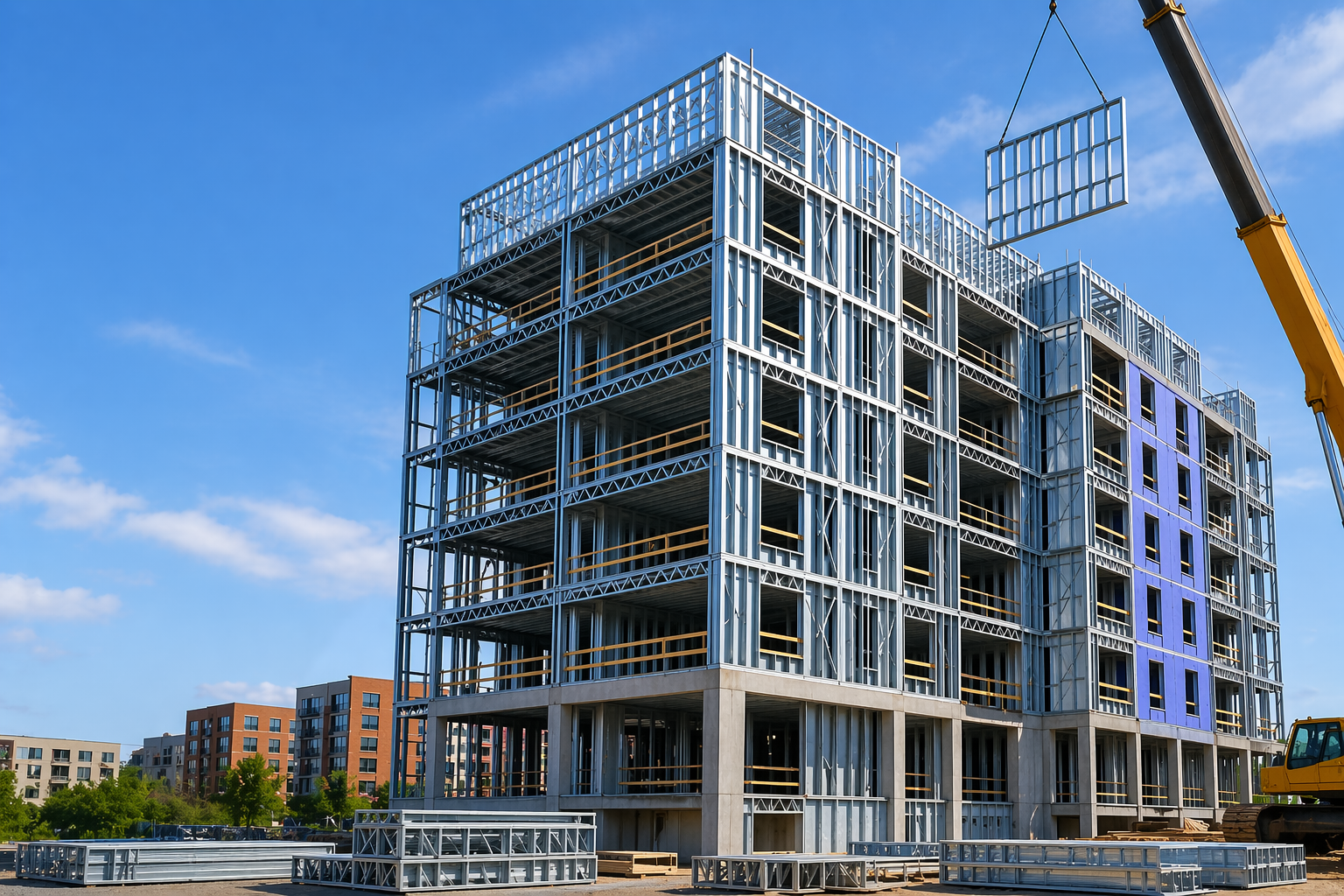
The Luxury Build Playbook: How Top Builders Create a Competitive Advantage
Luxury builders don’t get paid for effort.
They get paid for certainty.
Because in high-end custom and premium communities, the real product isn’t the framing package, the stone, or the window line. The real product is the client’s belief that you can deliver a complex build without surprises that threaten the schedule, the budget, or your reputation.
And that’s exactly where the fear lives for most premium builders:
- One missed detail becomes a visible finish flaw.
- One late decision becomes a two-week delay.
- One messy jobsite becomes a story the client repeats at dinner.
- One blown schedule becomes a balance-sheet problem on the next project because referrals slow down.
You already know the painful truth: in luxury, you don’t get judged by your average performance. You get judged by your worst moment.
This is the insider playbook top builders use to protect their reputation and create a competitive advantage through execution, predictability, and upstream control. It’s valuable even if you never change your framing method. But if you’re looking for an edge in 2026, it will also show you where select innovations—including panelized approaches—can remove failure modes that keep showing up on premium projects.
The Premium Builder’s Moat: Control Variability Upstream
Most problems in luxury construction aren’t “construction problems.” They’re variability problems.
Variability shows up as:
- A detail interpreted three different ways by three different crews
- Opening sizes drifting until windows fight back
- Substitutions that force last-minute redesign
- A beautiful plan that becomes a field improvisation exercise
- Finish trades doing structural correction with expensive materials and time
Top builders assume variability is inevitable. Then they build a system that contains it.
If you want a competitive advantage, stop asking:
“How do we build faster?”
and start asking:
“Where does variability enter—and how do we remove choices from the field?”
The Luxury Build Playbook
1) Sell a Schedule You Can Defend
The luxury buyer (and the high-end developer) is not afraid of premium pricing. They’re afraid of:
- Losing a season
- Missing a move-in window
- Carrying cost exposure
- A project that consumes their attention for 6 extra months
Premium builders don’t sell timelines based on optimism. They sell timelines based on control points:
- Dry-in date reliability
- Inspection predictability
- Trade stacking without congestion
- Finish start readiness (not calendar promises)
Practical lever: Build “schedule proof” into your process
- Create a list of the 10 schedule killers you see repeatedly (late windows, change-driven RFIs, framing drift, MEP conflicts, inspection resets, etc.).
- For each, define the upstream control that prevents it.
- Put those controls on your internal pre-start checklist.
This is how you become the builder who “does what they said”—a differentiator in any market.
2) Standardize the Assemblies That Create Luxury
Luxury feels custom, but premium execution is repeatable.
The best builders quietly standardize the assemblies that cause the most downstream pain:
- Window/door openings and water management
- Stair openings and alignment points
- Roof transitions and complex valleys
- Wet walls and stacked chases
- Fire/sound assemblies in high-end communities
They don’t standardize aesthetics. They standardize how the building behaves so the rest of the job stays predictable.
Practical lever: Create a “signature details” library
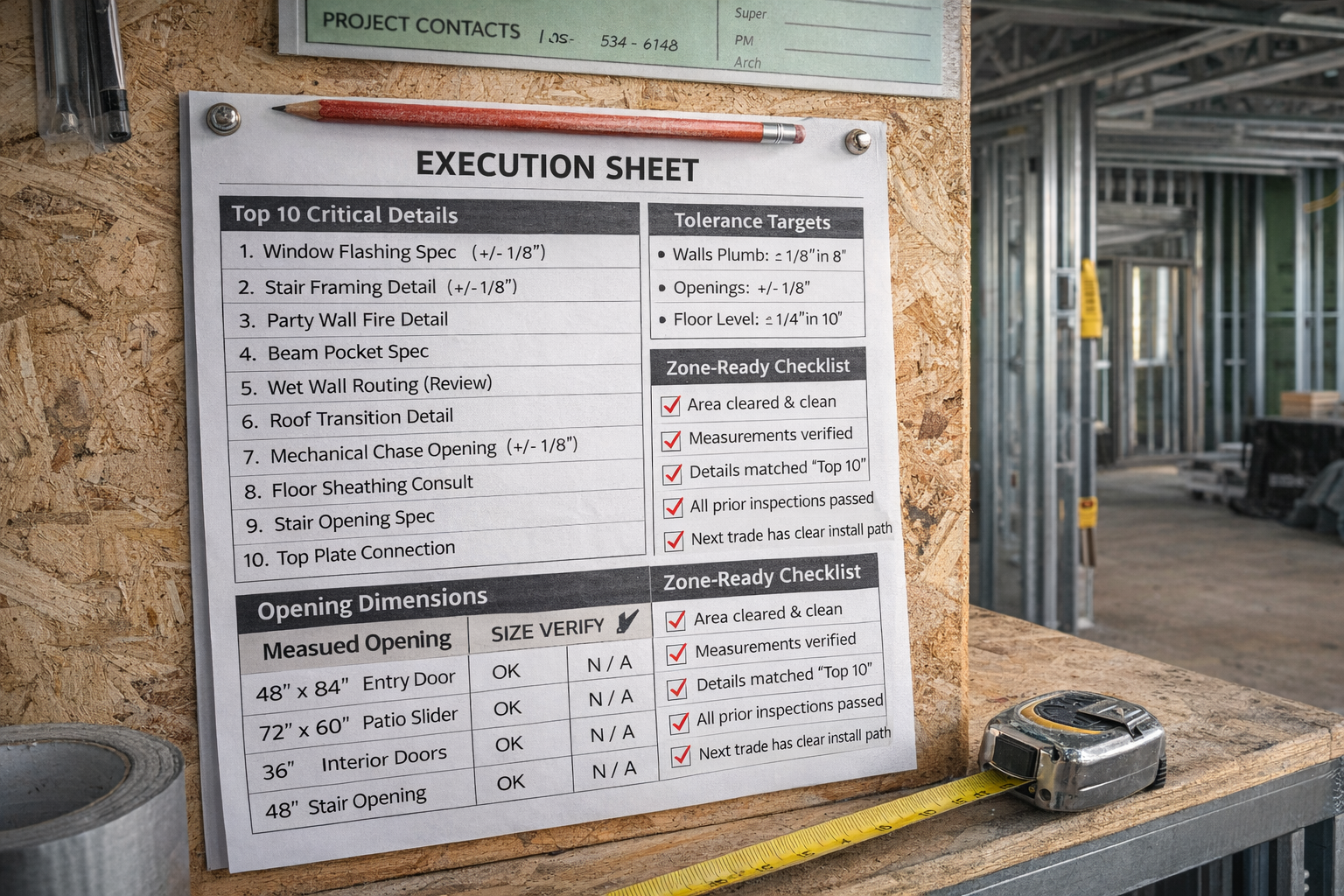
- 10–20 details you reuse constantly
- Each one includes tolerances, inspection notes, and “do-not-deviate” callouts
- One accountable owner updates them as lessons are learned
This reduces RFIs and field invention—the enemy of luxury.
3) Treat Tolerance Like a Profit Center
Premium finishes punish tolerance drift:
- Large-format tile shows minor variance
- Cabinet lines magnify out-of-plumb walls
- Shadow reveals expose uneven framing
- High-end window packages don’t forgive inconsistent openings
In luxury, tolerance isn’t “craftsmanship.” It’s risk management.
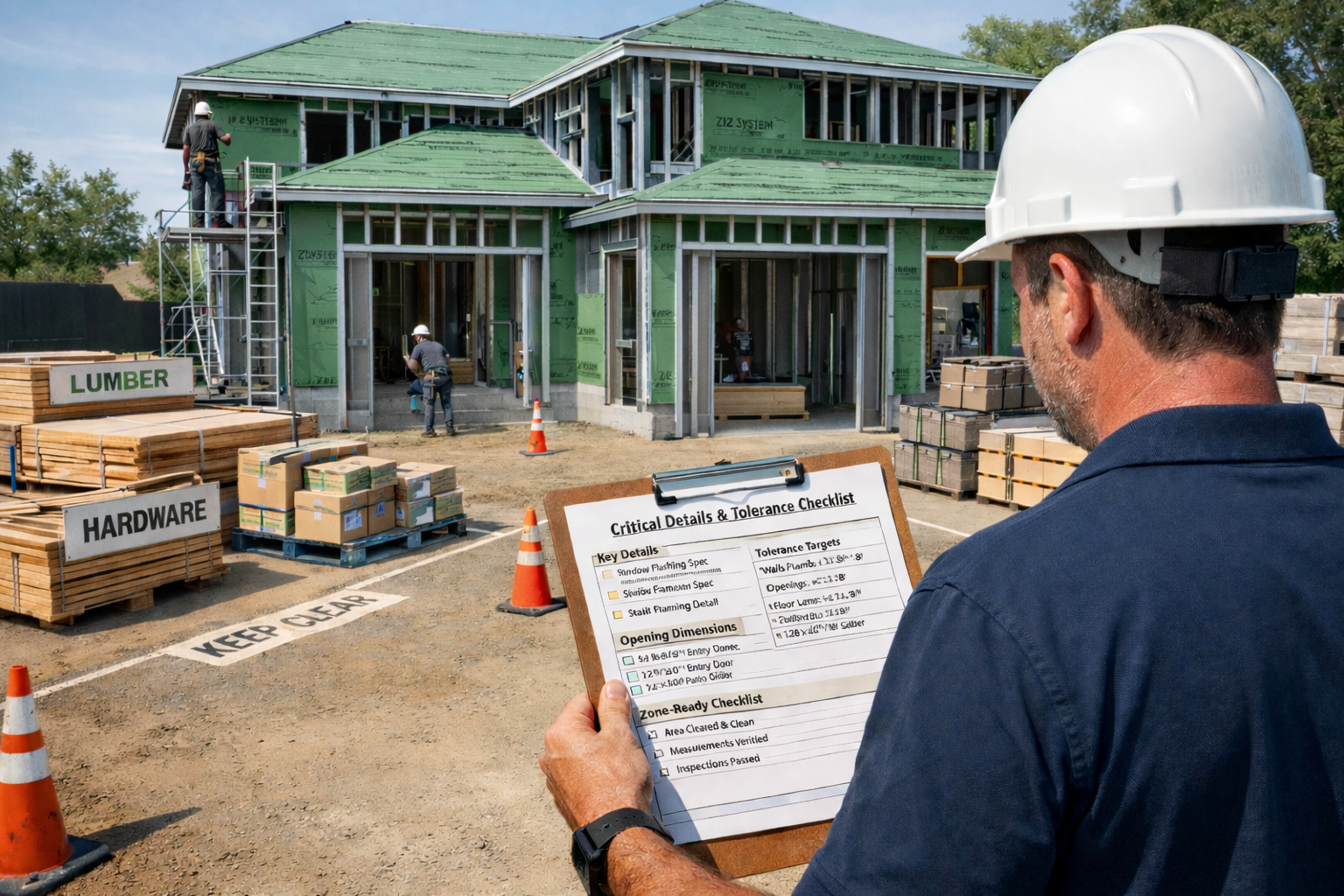
Practical lever: Install tolerance checkpoints early
- Wall plumb/straightness verification by elevation
- Opening verification tied to the window/door schedule
- Floor flatness checks in critical finish zones
- Document corrections before MEP and drywall
This is one of the most overlooked “competitive advantage” moves because it prevents expensive downstream correction that no one budgets for.
4) Replace Heroics With Preconstruction Gates
Luxury projects attract talented people. The trap is letting talent substitute for a system.
Top builders use “gates” that prevent the project from starting with unresolved ambiguity:
- No framing start until key transitions are resolved
- No penetrations through critical members without a defined path
- No “we’ll figure it out later” on mechanical chases
- No substitutions that affect assemblies without a signed impact review
Practical lever: A pre-framing coordination gate
A simple meeting, a checklist, and hard criteria for “ready.”
This is not bureaucracy. It’s how you stop paying premium pricing for late decisions.
5) Make Procurement a Strategy, Not a Reaction
In luxury, procurement issues are reputational issues. Late windows are not “a vendor problem.” They become:
- Schedule drift
- Trade stacking chaos
- Damage and rework
- A client who stops trusting the process
Practical lever: Locked scopes + early release packages
- Identify long-lead and high-impact items early
- Release them in controlled packages
- Pre-approve alternates that don’t change assemblies
The goal isn’t to eliminate substitutions. It’s to ensure substitutions don’t force redesign.
6) Run the Jobsite Like a Production Environment
High-end execution looks calm. Not because it’s easy—because it’s managed.
Premium builders treat the jobsite as a constrained system:
- Staging is planned
- Trades are sequenced by zone readiness
- Damage prevention is designed in
- Rework is treated as a failure mode, not “part of the job”
Practical lever: Zone-ready releases
A zone is either ready for the next trade, or it isn’t. Readiness has a checklist, not a feeling.
This reduces congestion, improves productivity, and eliminates the chaos that drives luxury clients (and developer partners) crazy.
Variability Map: Where Premium Projects Bleed Time and Reputation
The “luxury edge” comes from removing the biggest failure mode you see every month.
The Urgency: 2026 Rewards Builders Who Innovate in Execution
Luxury buyers are more informed. High-end developers are more data-driven. And both groups are less patient with:
- “Normal” delays
- Field improvisation
- Rework disguised as craftsmanship
- Schedule promises that depend on perfect conditions
Builders who innovate in execution will separate from the market because they can prove:
- predictable outcomes
- fewer surprises
- cleaner finishes
- better experience
- less capital exposure
Innovation doesn’t mean adopting every new system. It means removing recurring failure modes. And one of the biggest recurring failure modes in premium projects is field variability during framing—because framing sets the tolerances that everything else inherits.
That’s where a set of optional “upstream control” levers comes in.
Optional Levers: Ways Top Builders Control Variability Upstream
Think of these as tools—not ideologies. The right mix depends on project type, team strength, and risk tolerance.
Lever A: Preconstruction Coordination + BIM Where It Actually Matters
You don’t need “full BIM” to benefit. You need coordination where mistakes are expensive:
- stacked wet walls
- steel beams and bearing points
- mechanical chases and structural conflicts
- complex roof geometry
Lever B: Repeatable Assemblies and a Prototype Discipline
High-end communities and repeatable custom models benefit from:
- locking a prototype
- standardizing details
- resisting midstream changes that destroy repeatability
The compounding advantage comes from doing the hard thinking once, then deploying consistently.
Lever C: Targeted Prefabrication
Selective prefabrication can reduce jobsite congestion and interpretation risk:
- truss packages
- certain wall assemblies
- complex roof components
- pre-cut or pre-kitted materials where logistics are a pain point
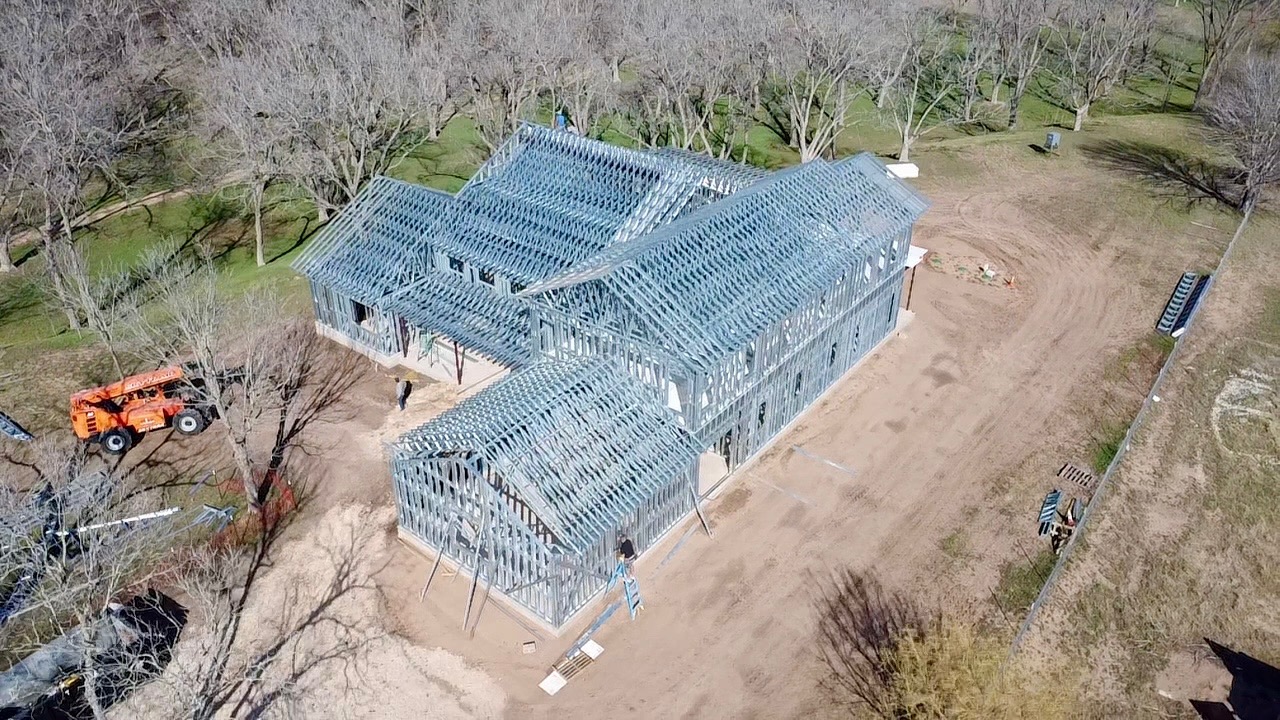
Lever D: Cold Formed Steel Framing as a Tolerance + Repeatability Tool
Cold Formed Steel Framing (and related workflows) can be evaluated as a lever for:
- straighter walls
- more consistent openings
- predictable assemblies that protect finish quality
- reduced susceptibility to jobsite variability (when coordinated correctly)
It’s not inherently “better.” It’s more controllable in specific use cases—particularly when tolerance and repeatability matter more than tradition.
Lever E: Panelized Metal Framing as One High-Leverage Implementation
This is where panelized metal framing fits—but as part of the broader playbook, not the headline.
Panelization is essentially a method of moving key decisions upstream:
- standardizing assemblies
- tightening dimensional control
- reducing field interpretation
- staging installs in predictable sequences
For some builders and developers, it becomes a powerful lever because it targets a root cause: variability introduced during framing that cascades into every downstream trade.
But the real value isn’t “panelized.” The real value is controlling variability before it hits the field.
That’s the throughline of premium execution.
How Mainefactured Framing Thinks About This
The most reliable projects aren’t the ones with the most talent. They’re the ones with the fewest uncontrolled decisions made on site.
At Mainefactured Framing, we look at framing less as a scope and more as a variability-control system:
- How do you make openings repeatable?
- How do you prevent tolerance drift from becoming finish rework?
- How do you compress the critical path by reducing field improvisation?
- How do you protect reputation by preventing avoidable chaos?
Whether a builder uses stick-built methods, targeted prefabrication, cold-formed steel, or panelized workflows, the goal is the same:
Build a delivery system that performs under imperfect conditions.
That’s what premium builders are really selling.
The Builder’s Next Move: One Change That Creates a Disproportionate Advantage
If you want this playbook to pay off quickly, don’t try to overhaul everything.
Pick one recurring failure mode and remove it upstream:
- Opening inconsistency → opening verification + standardized assemblies
- Roof complexity → prototype lock + pre-framing gate
- Trade congestion → zone-ready releases
- Finish rework → tolerance checkpoints
- Late decisions → coordination gates
That’s how premium builders protect margins and reputation while everyone else fights fires.
And it’s how you win in a market where design is table stakes, but execution is still rare.
Related posts
SEE ALL POSTS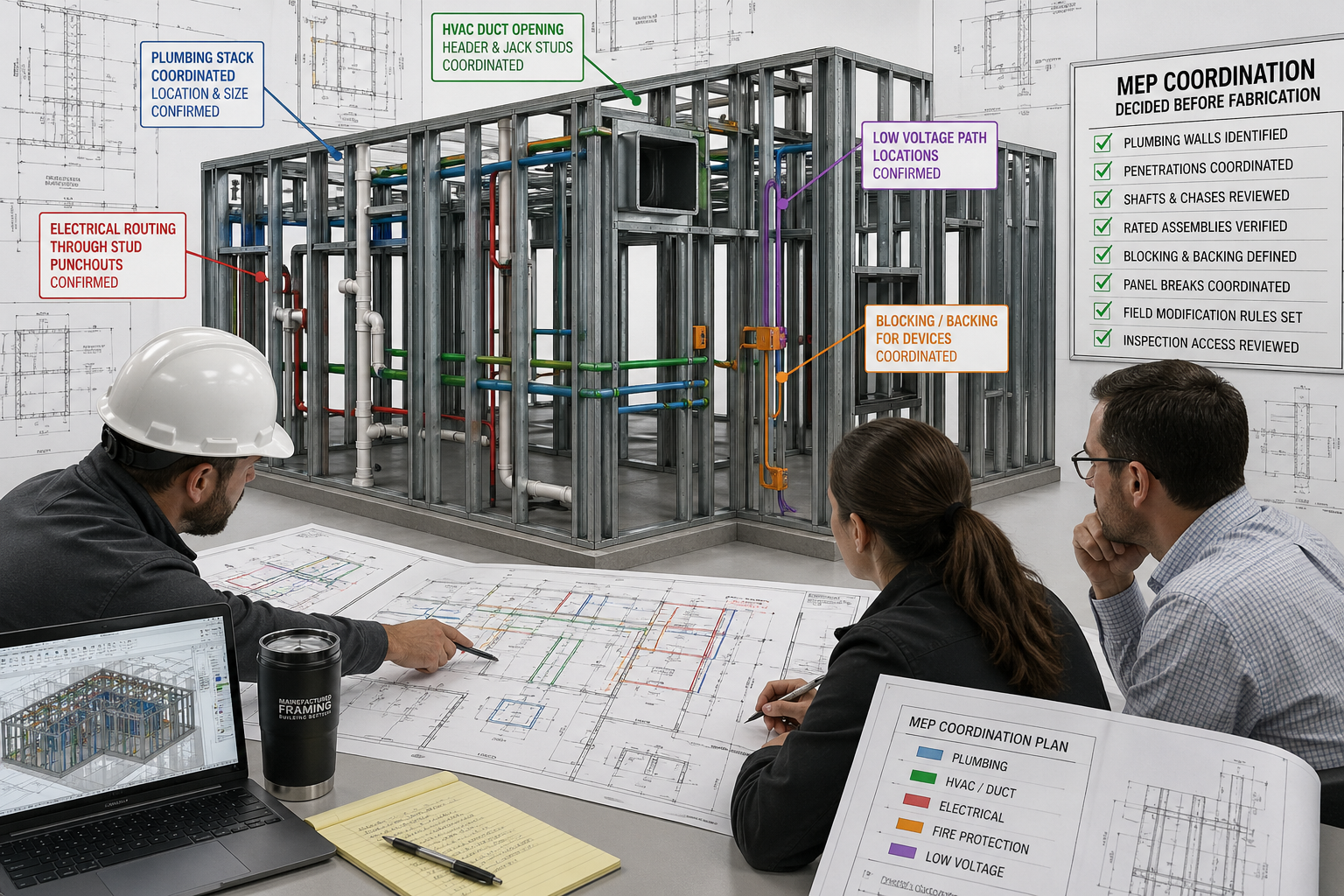
MEP Coordination in Panelized Cold-Formed Steel: What Must Be Decided Before Fabrication
Cold-Formed Steel for Custom Homes: What High-End Builders Need to Know