Hotel Developers Are Leaving Money on the Table With Stick Framing
Hotel development is a timing business disguised as a building business.
The revenue clock starts when keys hit the front desk, not when the slab is poured. And every week of schedule noise compounds into real money: extended general conditions, delayed FF&E installation, deferred hiring/training, and missed seasonal demand windows.
That’s why hotel framing deserves a different standard than “lowest bid, then hope the field figures it out.”
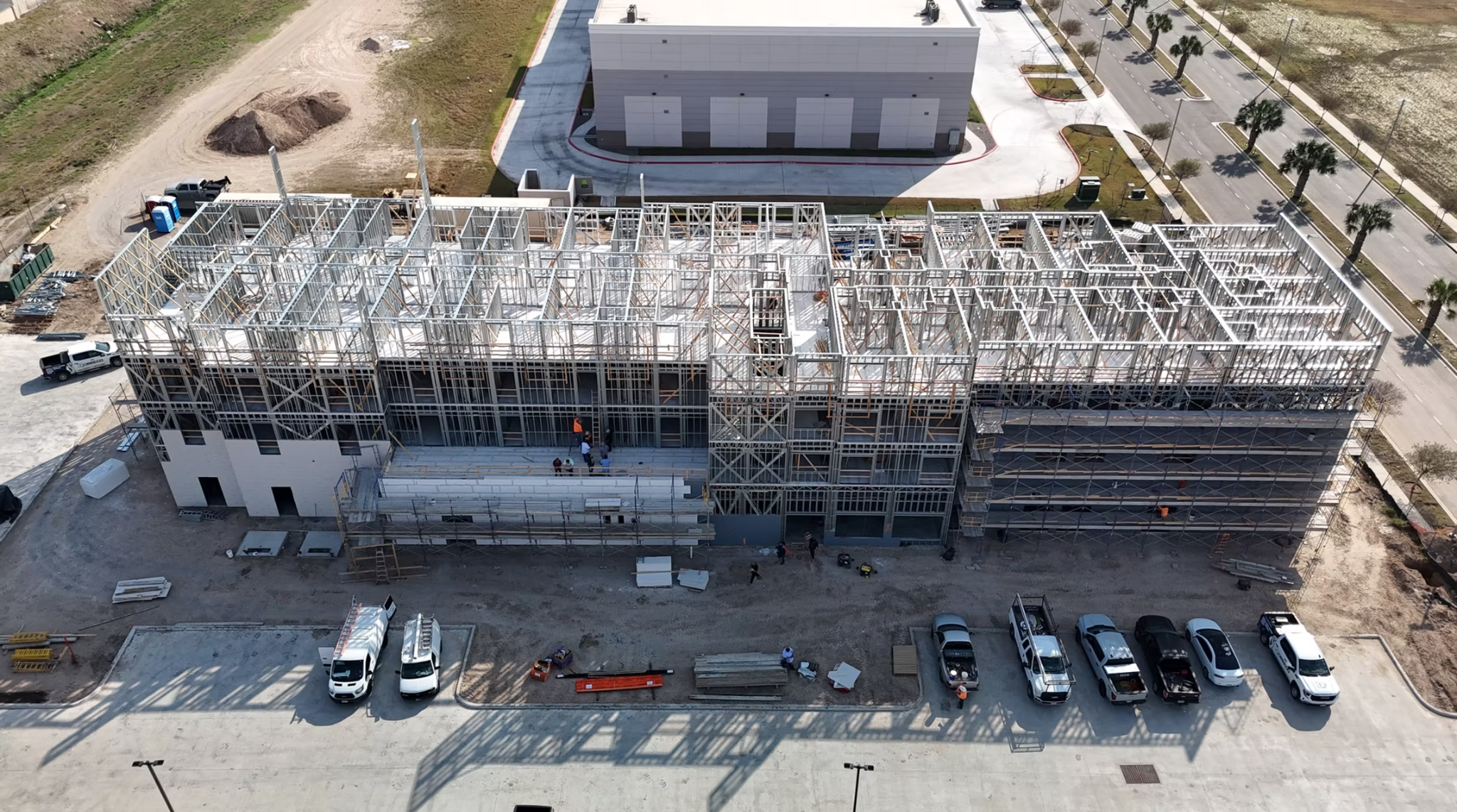
Panelized metal framing (factory-built wall panels and floor/roof trusses) gives hotel teams a structural delivery method that behaves more like an engineered system than a commodity scope. When it’s done right, it doesn’t just make framing faster. It makes the project more predictable.
Why panelized metal framing fits hotels unusually well
Hotels are one of the most repeatable building types in the market. Repetition isn’t just a design characteristic, it’s a manufacturing advantage.
A typical hotel has:
- A high percentage of identical room bays
- Stacked wet walls and repeated corridor conditions
- Tight opening and finish tolerances (doors, frames, casework, tile, glass)
- A schedule where dry-in and interior start dates are everything
That combination is exactly where panelization pays.
The real benefit: moving decisions upstream
Most framing pain isn’t caused by the material. It’s caused by when decisions get made.
Conventional site-built framing often forces coordination decisions into the field:
- Openings get “tuned” on-site
- Wall lines drift to avoid MEP clashes
- Headers, backing, and deflection details become interpretation
- Corrections show up downstream as finish friction
Panelization flips that. The project is forced to resolve structure and coordination before framing starts, while changes are still cheap and the jobsite isn’t paying for improvisation.
Competitive advantage for developers: predictable openings, predictable rooms, predictable turnover
Developers don’t win by saving a few cents per square foot on studs. They win by controlling uncertainty.
Panelized framing helps in three developer-critical ways:
1) Schedule reliability (not just “speed”)
Hotels don’t need heroic framing days. They need repeatable cycle time.
Panelized framing reduces variables that typically break schedule:
- Less cutting and sorting on site
- Less congestion around stair cores and corridors
- Faster set-and-brace sequencing
- Earlier dry-in (less weather exposure on the critical path)
The difference shows up as fewer “gray days” where a crew is on site but progress is limited by coordination or rework.
2) Finish quality and tolerance control
Hotel interiors punish framing variability.
If walls aren’t straight and openings aren’t consistent, the cost doesn’t always land in framing. It lands later:
- Door/frame problems
- Tile and waterproofing headaches
- Millwork/casework adjustments
- Glass and drywall waves
- “Field fixes” that become warranty issues
Panelized metal framing is inherently better positioned to deliver straighter assemblies because it’s built on controlled tables/jigs with consistent labeling and repeated details. The result is less downstream friction, especially in corridors and room entry conditions where tolerance stacks fast.
3) Risk distribution shifts away from the jobsite
Developers live with two kinds of risk:
- Known costs (you can budget them)
- Unknown costs (you can’t control them)
Panelization reduces the unknowns by shrinking the portion of framing that depends on daily field decisions. Less improvisation means fewer surprises, fewer late RFIs, and fewer cascading impacts across trades.
Where hotels typically gain the most
Hotels tend to see the biggest upside from panelized framing in:
- Guestroom floors (high repetition)
- Corridor wall runs (long, tolerance-sensitive, MEP-heavy)
- Stairs/elevators interfaces (coordination-critical transitions)
- Roof truss and parapet conditions (details that can be standardized)
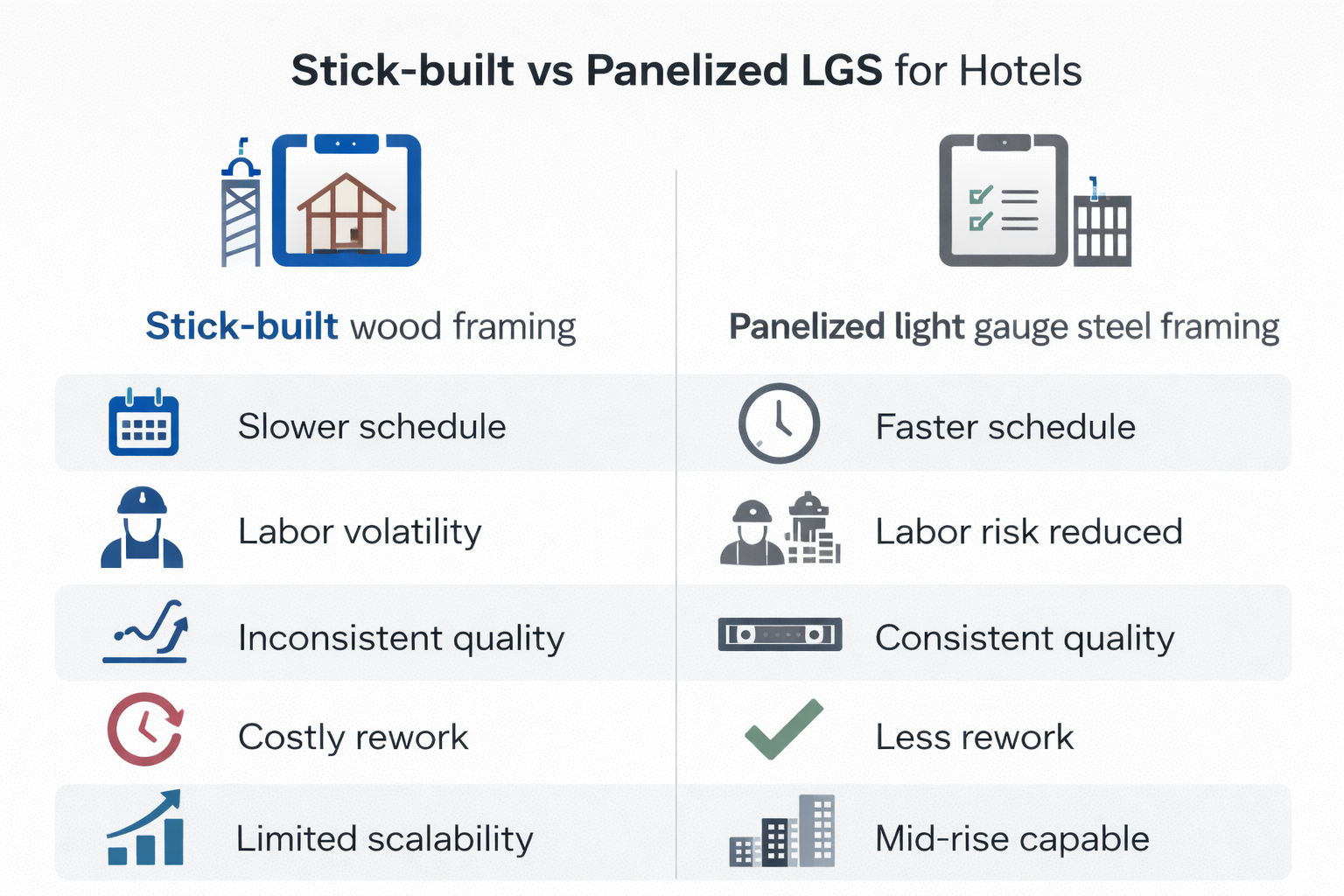
To make the decision tangible, here’s how the framing approach changes project behavior:
The non-negotiable: involve the panelizer during design, not after CDs
Panelized framing rewards discipline. The system works best when design decisions support repeatable manufacturing.
If you bring a panelizer in after the design is “done,” you often end up with one of two outcomes:
- Panelization becomes limited (you lose the biggest ROI), or
- The panelizer is forced to price risk and complexity (you pay for design decisions you could have avoided)
Pulling the panelized framing partner into the project during early design and DD allows the framing system to be optimized, not just “applied.”
The design rules that make or break panelization in hotels
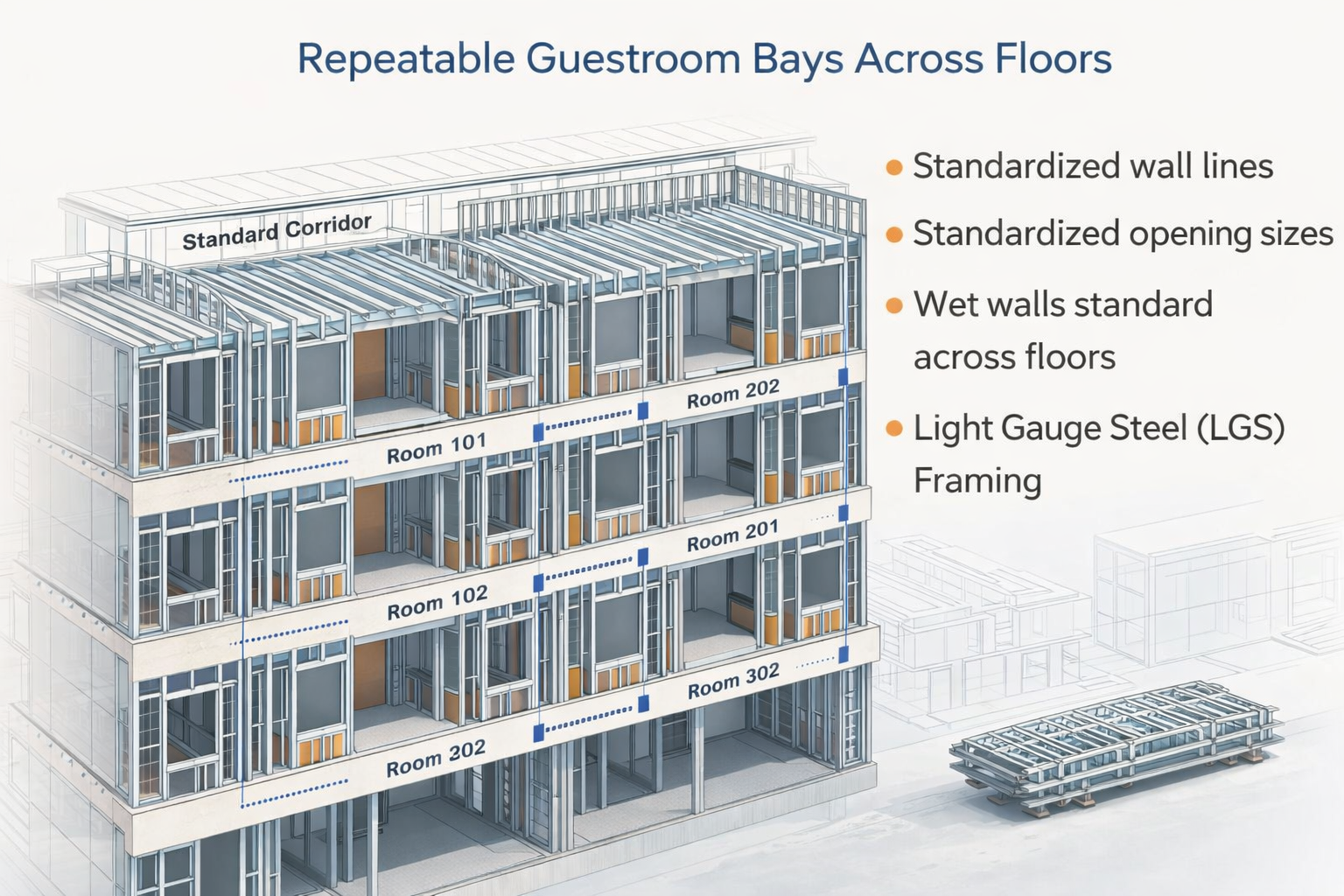
1) Repeatable room design across floors
Hotels are perfect for standardization, but only if the prototype stays locked.
What to standardize:
- Typical room wall types
- Bathroom wet wall assemblies
- Corridor-to-room demising details
- Window head/sill conditions
- Door opening sizes and hardware tolerances
- Backing packages (TV, headboard, grab bars, accessories)
When those become repeatable, panelization becomes a scaling engine instead of a one-off custom fabrication exercise.
2) Wall lines that stack cleanly (vertical alignment)
Stacking matters because it drives:
- Load paths
- Panel geometry
- Deflection control
- MEP shaft planning
- Fire and acoustic continuity
Misalignment across floors creates transfers, patchwork framing, and field-built exceptions. Hotels with clean stacked walls build faster and with fewer downstream coordination failures.
3) Opening sizes and “hotel tolerance reality”
Openings aren’t just architectural rectangles. They are operational risk points.
Panelization improves opening consistency, but only if the design avoids unnecessary variation:
- Standardize window sizes where possible
- Avoid multiple head heights without structural reason
- Keep door types consistent by room class (standard/ADA/suite)
- Simplify transitions at corridor ends and amenity portals
The best hotel framing packages treat openings like a controlled product, not a field art form.
4) Roof span and truss strategy
Hotels often hide complexity at the roof: parapets, MEP curbs, screen walls, and long spans over lobbies/amenities.
A panelized LGS approach typically benefits from:
- Early roof framing strategy alignment (span direction, bearing points)
- Standard parapet details (especially at corners and step-ups)
- Clear coordination of rooftop equipment zones and curbs
If roof framing is designed without regard for fabrication and sequencing, it can become the schedule bottleneck that wipes out gains made in guestrooms.
Mid-rise reality: reaching 7 stories with light gauge steel when designed correctly
When hotel developers push into mid-rise height, the framing conversation changes.
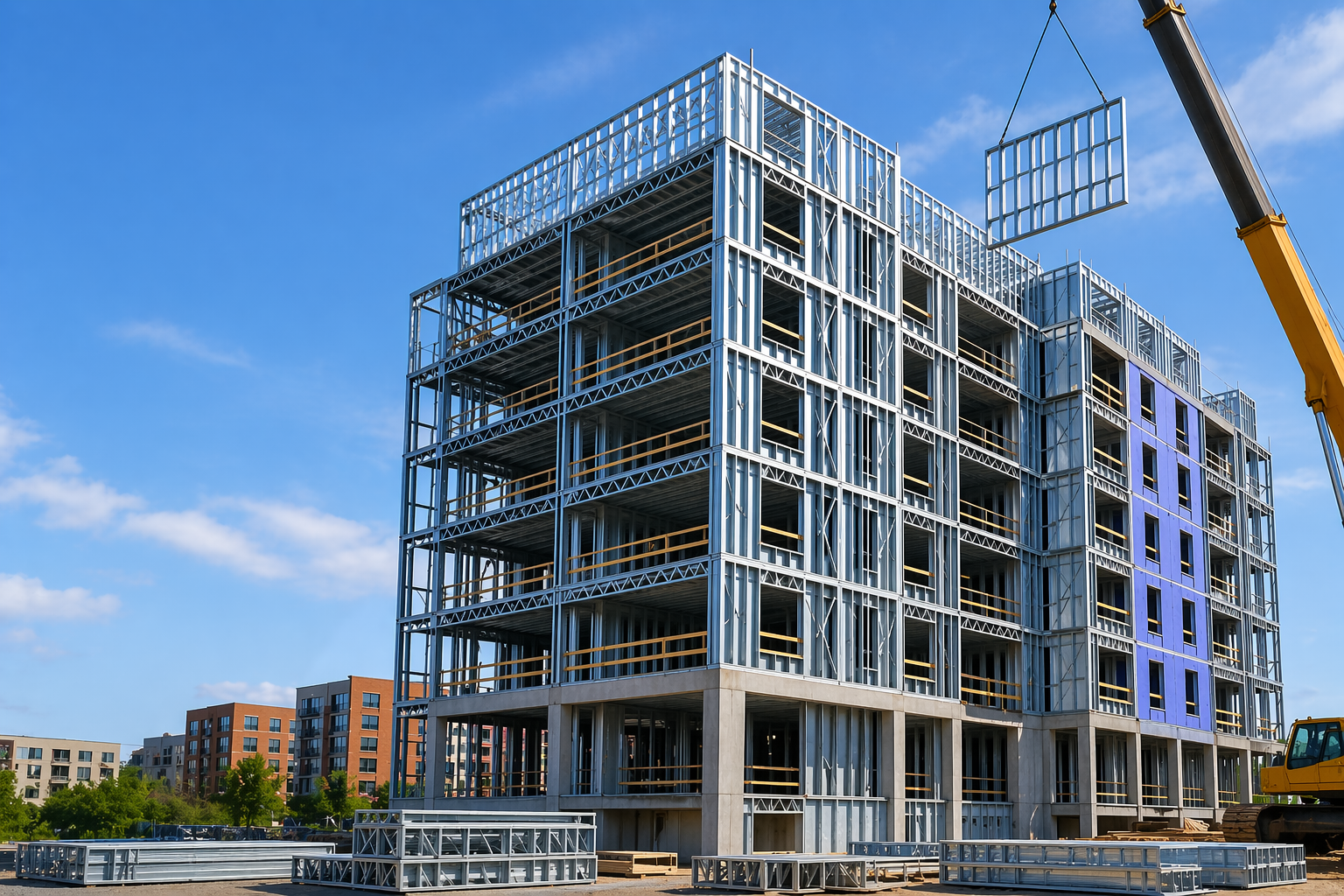
Many conventional light wood approaches face practical constraints tied to code pathways, combustibility, detailing complexity, and risk management. In contrast, light gauge steel framing systems can be designed for mid-rise hotel applications (including 6–7 stories) when the structural concept, load paths, and detailing are coordinated from the start.
The key phrase is when designed correctly.
Cost effectiveness at this height is driven by:
- A disciplined structural grid
- Repeatable wall and opening strategy
- Consistent load paths (minimizing transfers)
- Controlled deflection criteria (protecting finishes)
- Early coordination of rated assemblies, acoustics, and MEP penetrations
If the building is “architecturally creative” in ways that break repetition, you can still build it, but you’ll pay for complexity. Panelized framing doesn’t remove physics or coordination, it simply makes them visible early enough to manage.
Cost overview: what panelized LGS typically looks like for a hotel
Developers want ranges that are usable in feasibility and early pro formas, not vague promises.
For hotel projects, a practical budgeting framework for panelized light gauge steel often looks like:
Design, engineering, and manufacturing (panels + trusses)
$14–$16 / SF (of building area, depending on scope definition and complexity)
This typically includes:
- Framing model development aligned with architectural set
- Engineering integration (as required by project delivery method)
- Fabrication of wall panels
- Fabrication of trusses (roof and/or floor trusses where applicable)
- Labeling, packaging, and shipment-ready sequencing
Variables that push cost up:
- Excessive wall type variation
- Misaligned floor-to-floor geometry requiring transfers
- Highly customized opening schedules
- Frequent changes after coordination begins
Erection / installation
$5–$6.50 / SF (depending on local labor rates and site logistics)
Variables that affect erection pricing:
- Crane access and pick paths
- Staging space and material handling plan
- Weather exposure and site constraints
- Complexity of cores, amenity levels, and roof geometry
Important budgeting note: Hotels also carry meaningful value in schedule compression, but that’s typically reflected in reduced carrying costs and earlier revenue, not always in the framing line item alone.
Why the right partner matters more than the material
Steel framing is not the differentiator by itself. Delivery method is.
Panelized framing works when your partner can do three things well:
- Design-assist early enough to protect repetition and stackability
- Value engineer details so the system is buildable, not just “code-compliant on paper”
- Package for assembly so erection is a controlled process, not a field experiment
This is where developers quietly separate outcomes.
A framing partner that understands panelization as a system will push the project toward:
- Fewer wall types
- Cleaner load paths
- Standardized openings and backing
- Smarter roof framing decisions
- Clear zone-by-zone installation sequencing
That’s how you turn panelization into competitive advantage instead of a procurement label.
At Mainefactured Framing, our bias is to treat hotel framing like a manufacturing and assembly problem: upstream coordination, repeatable assemblies, and jobsite sequencing that reduces variability. Not because it sounds good, but because that’s how you protect schedule and reduce downstream rework when stakes are high.
Honest trade-offs developers should understand
Panelized metal framing is not magic. It’s a different discipline.
Here are the trade-offs that matter in hotel decision-making:
You must commit earlier
Panelization rewards early decisions:
- Room prototype locked
- Opening schedule stabilized
- Coordination milestones respected
If a team is still “designing in the field,” the system will feel restrictive. In reality, it’s just enforcing discipline that the schedule needed anyway.
Change management becomes more consequential
Late changes can be done, but they’re more expensive because they ripple through fabrication, packaging, and sequencing. The upside is that many issues get discovered earlier, when they’re cheaper to solve.
The preconstruction process matters more
The biggest wins happen before the first panel ships:
- Coordination quality
- Shop package clarity
- Sequencing plan realism
- Logistics and pick plan alignment
Developers who treat that phase as optional typically don’t realize the full ROI.
The bottom line for hotel developers
Hotel projects punish uncertainty: labor swings, weather exposure, downstream tolerance issues, and late coordination.
Panelized metal framing doesn’t just speed up framing. It changes the risk profile of the build by shifting decisions upstream, enforcing repeatable assemblies, and turning erection into a controlled installation sequence.
When the hotel is designed for repetition, stacked wall lines, and standardized openings, the system scales cleanly. And when the delivery partner is engineering-driven and assembly-focused, it becomes one of the most reliable ways to protect schedule in a category where schedule is revenue.
Related posts
SEE ALL POSTS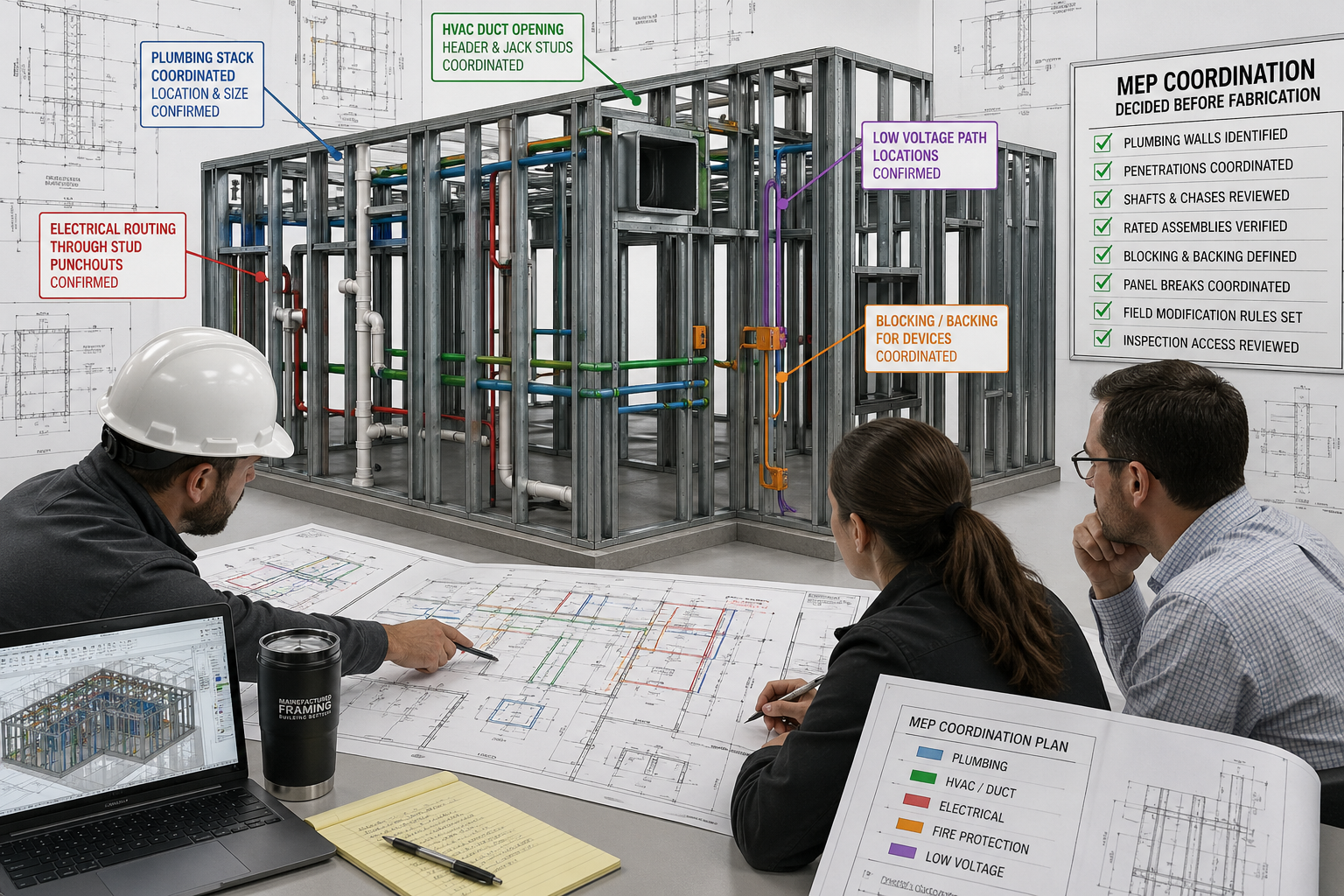
MEP Coordination in Panelized Cold-Formed Steel: What Must Be Decided Before Fabrication
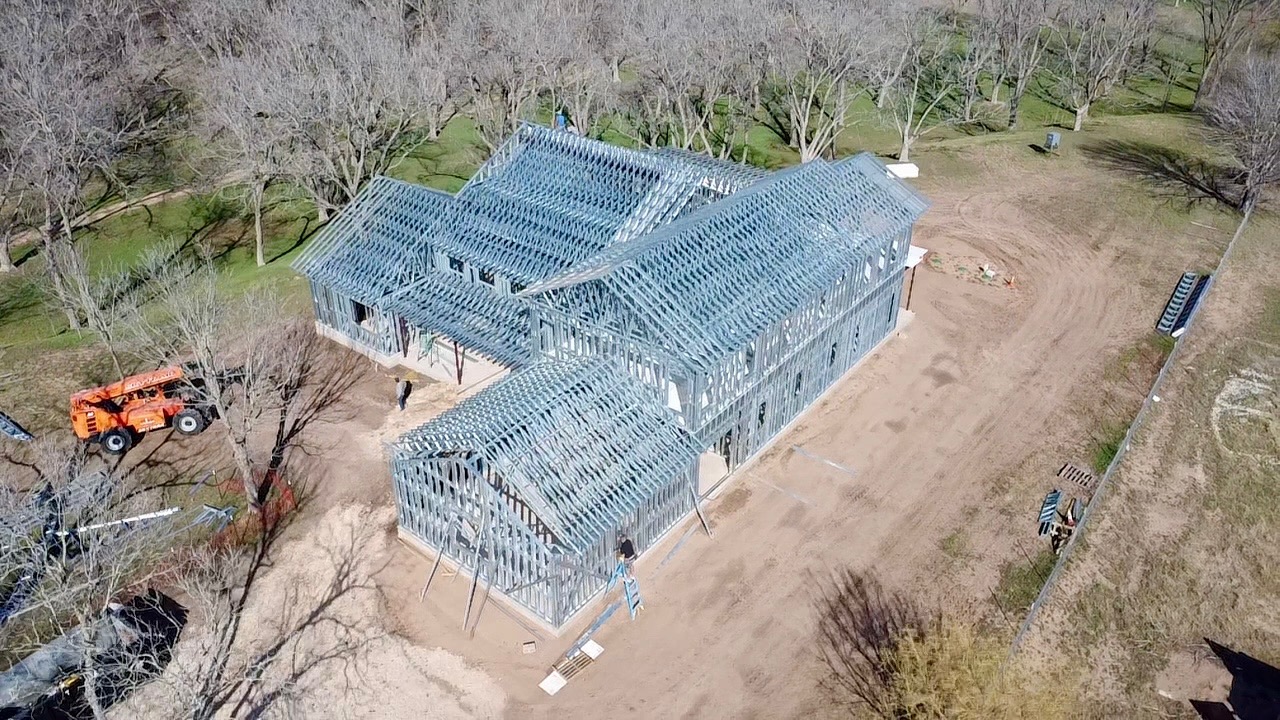
Cold-Formed Steel for Custom Homes: What High-End Builders Need to Know