MEP Coordination in Panelized Cold-Formed Steel: What Must Be Decided Before Fabrication
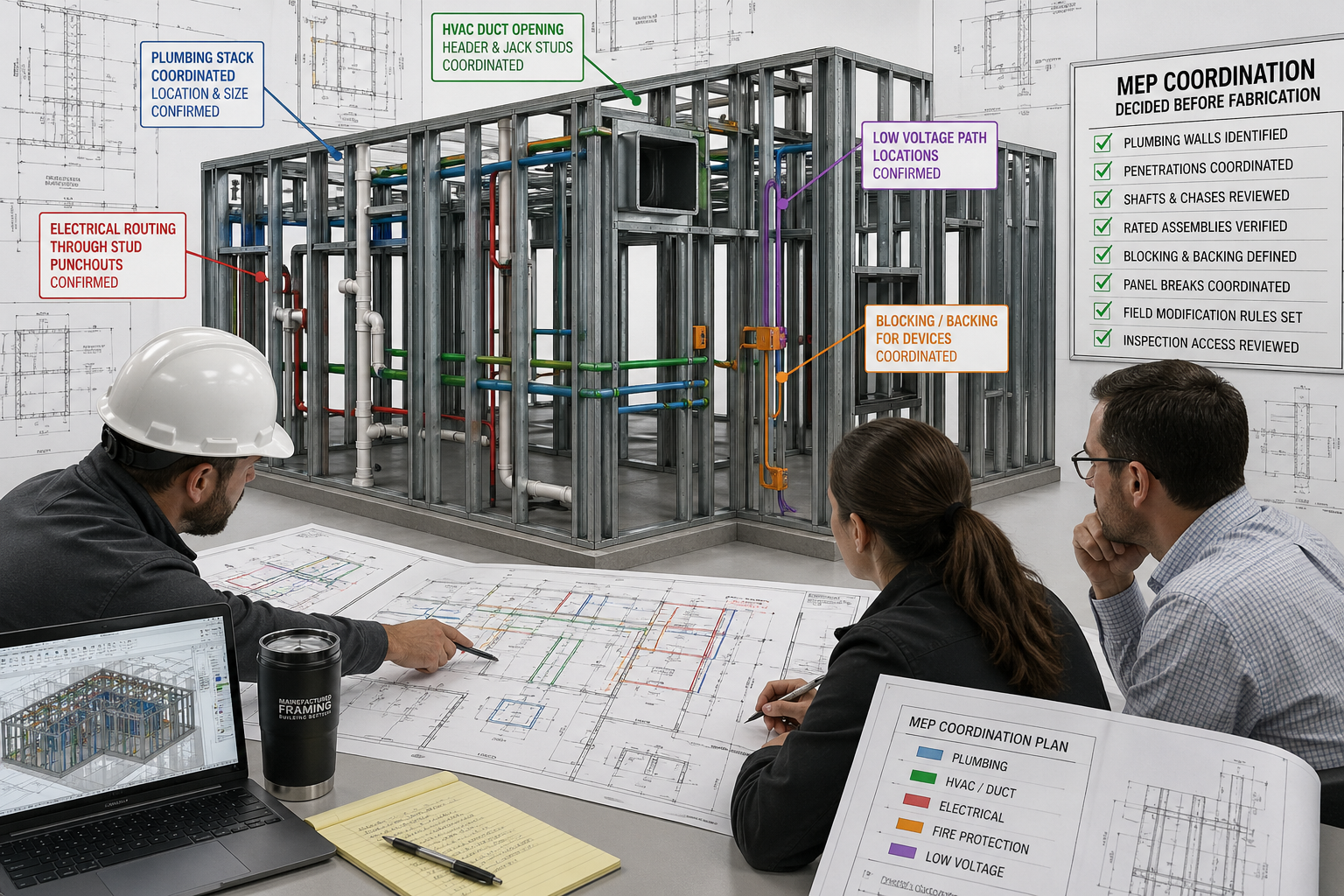
Panelized cold-formed steel framing can reduce jobsite variability, shorten the framing window, and create a more predictable path from structure to dry-in. But those benefits depend on one major condition: the building team has to make certain decisions earlier.
MEP coordination is one of the clearest examples.
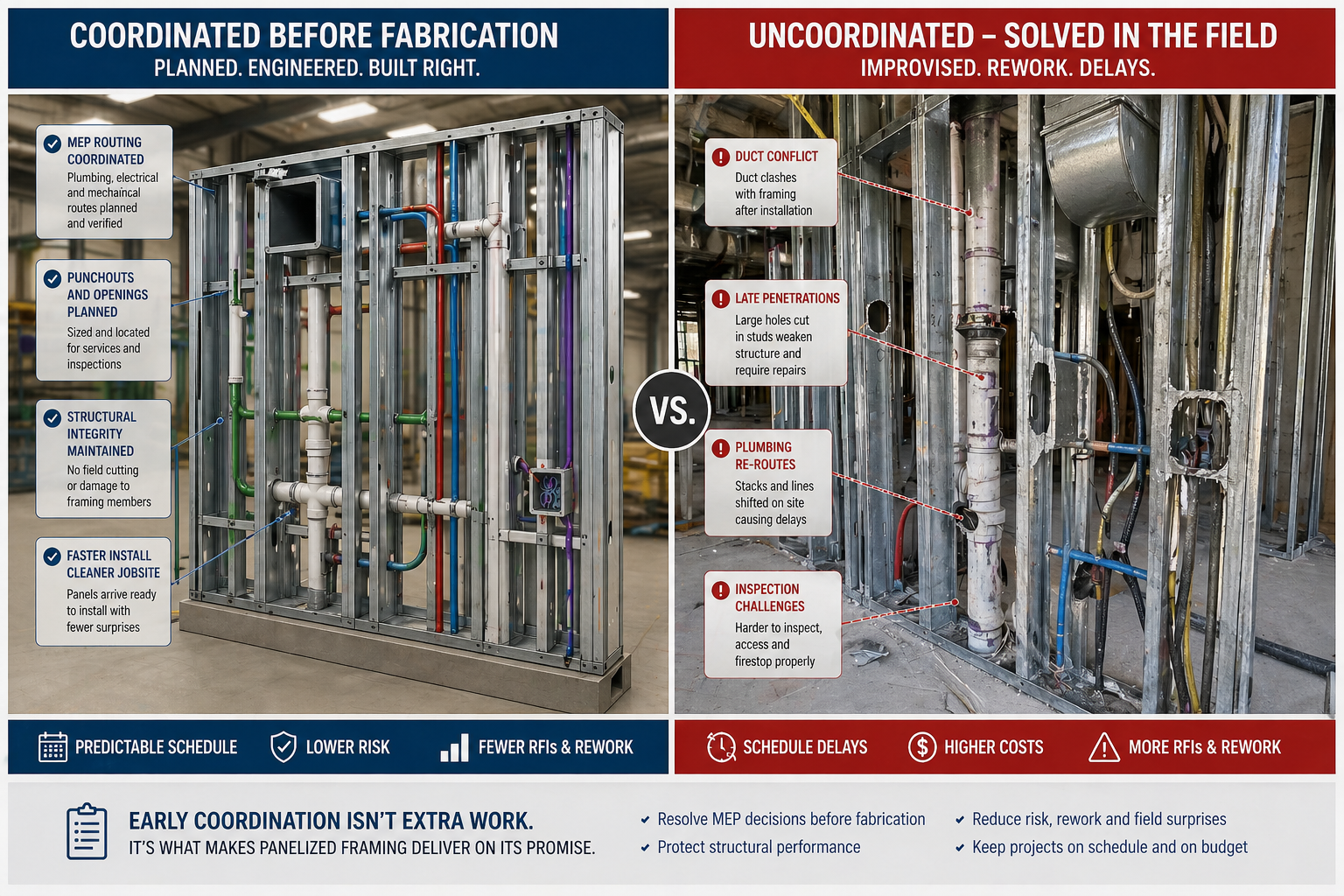
In conventional site-built framing, mechanical, electrical, and plumbing conflicts are often discovered and resolved in the field. A plumber needs a route. An electrician needs a chase. A mechanical contractor needs clearance. The framing crew adjusts, cuts, drills, reinforces, or waits for direction. That flexibility may feel useful, but it often hides cost, rework, inspection risk, and schedule drag.
Panelized metal framing changes the timing of those decisions.
Because panels are fabricated offsite, the wall system is no longer a loose collection of studs and tracks assembled entirely in the field. It becomes a coordinated framing package. Stud layouts, openings, bracing, headers, panel breaks, labels, and connection details are resolved before the panels arrive. That means MEP routing needs to be understood before fabrication, not discovered after the walls are standing.
This does not mean every conduit, pipe, duct, sleeve, and box must be fully modeled to fabrication-level detail on every project. It does mean the project team must identify the MEP conditions that affect framing integrity, panelization logic, inspection flow, and installation sequence.
For developers, general contractors, architects, and MEP teams, the question is not whether panelized cold-formed steel can accommodate MEP systems. It can. The real question is whether the right decisions are being made early enough to avoid turning a controlled system back into a field coordination exercise.
Why MEP Coordination Matters More in Panelized Metal Framing
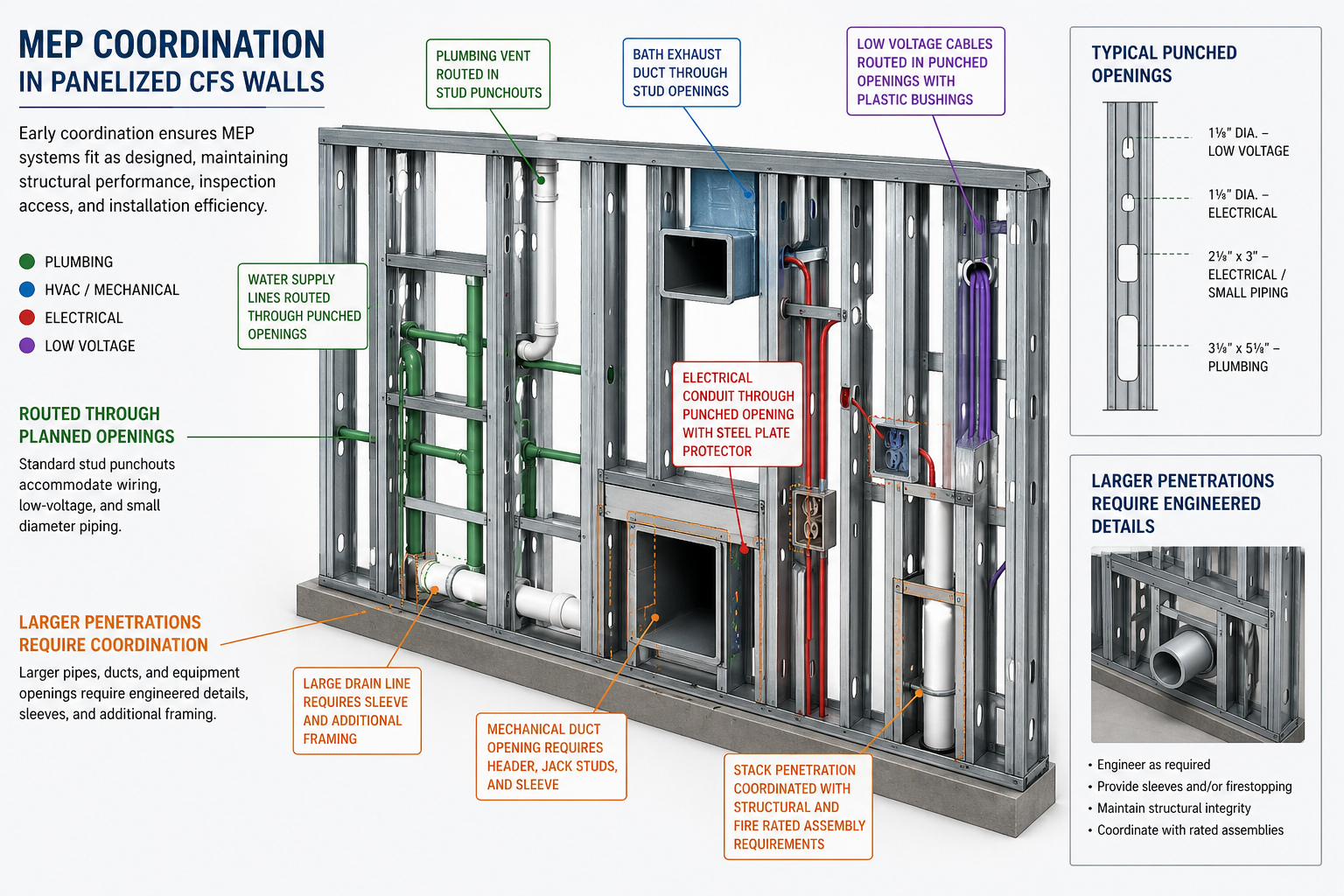
Cold-formed steel framing is highly compatible with mechanical, electrical, and plumbing systems when the coordination is handled properly. Steel studs commonly include punchouts or web openings for routing smaller services, and engineered framing systems can be detailed to accommodate larger penetrations where needed. Industry technical resources such as AISI S240 address cold-formed steel structural framing requirements, while SFIA technical guides provide design and product information for cold-formed steel members used in construction.
The challenge is not compatibility. The challenge is timing.
Panelized framing deliberately moves labor and decisions upstream. That is where much of the schedule value comes from. Fabrication can happen while sitework, foundations, podium work, or other predecessor activities are progressing. Panels can arrive labeled, sequenced, and ready for installation. Field crews spend less time cutting, sorting, measuring, and solving repetitive conditions.
But if MEP routing is unresolved, that advantage starts to erode.
Late MEP decisions can create several problems:
- Field-cut studs or tracks
- Oversized or misplaced penetrations
- Conflicts with bracing, headers, holdowns, or panel joints
- Delayed inspections
- Requests for engineered repairs
- Trade stacking after panels are installed
- Rework around shafts, chases, corridors, and rated assemblies
Manufacturers offer repair products for field-modified cold-formed steel members, including products intended to restore strength and stiffness after oversized cutouts or damaged flanges. The existence of these repair methods is useful, but it also illustrates the point: field modification should be controlled, reviewed, and minimized rather than treated as the default coordination strategy.
In a well-managed panelized CFS project, MEP coordination is not a separate exercise that happens after framing. It is part of the framing strategy.
The Core Principle: Do Not Fabricate Around Assumptions
Panelized metal framing rewards clarity. It punishes vague assumptions.
Before fabrication, the framing team needs enough information to answer a practical set of questions:
This is where experienced panelized CFS providers create value. The goal is not simply to manufacture panels. The goal is to force the right coordination conversations before fabrication begins.
That upstream discipline can feel slower at first. In reality, it is often what prevents schedule loss later.
Plumbing: The Most Common Source of Framing Coordination Pressure
Plumbing usually creates the most challenging MEP conditions in panelized CFS framing because pipes often require larger clearances than electrical wiring or low-voltage systems.
Water supply lines may route through standard stud punchouts depending on size and layout. But drain, waste, and vent lines require more attention. Larger pipes, vertical stacks, wet walls, offsets, cleanouts, and floor-to-floor transitions can all affect framing design.
Before fabrication, the team should identify:
Which Walls Are True Plumbing Walls
Not every wall with a fixture is a plumbing wall from a framing standpoint. The critical question is whether the wall carries meaningful pipe volume, vertical stacks, horizontal offsets, or large-diameter services.
In multifamily, hotels, and repeatable residential projects, this often includes:
- Bathroom wet walls
- Kitchen and laundry walls
- Back-to-back unit plumbing walls
- Corridor-adjacent plumbing runs
- Mechanical room and utility walls
- Shaft-adjacent walls
If these walls are not identified early, the fabrication model may treat them like typical partition or load-bearing walls when they actually need different coordination.
Whether Stud Punchouts Are Enough
Cold-formed steel studs often include pre-punched openings for service routing. These are useful for electrical, low-voltage, and smaller mechanical or plumbing lines when they align with the intended route.
But standard punchouts are not a substitute for plumbing coordination. Larger holes, nonstandard routes, or concentrated pipe banks may require specific detailing, alternate stud orientation, additional framing, or engineered reinforcement.
The decision should be made before fabrication, not after a plumber is standing in front of an installed panel with a saw.
Where Chases Are More Efficient Than Penetrations
Sometimes the best framing solution is not to force services through studs. It is to create a chase.
A chase can simplify installation, preserve framing integrity, improve inspection access, and reduce conflict between trades. This is especially important when multiple services converge in a small area.
For repeatable plans, a well-designed chase can become a standardized coordination detail that improves future phases.
Electrical: Usually Easier, But Still Needs Rules
Electrical coordination is often more forgiving than plumbing, but it still needs structure.
Most electrical wiring can route through stud punchouts when the wall layout is understood and the penetrations are properly protected where required. The bigger issues tend to involve box locations, service panels, corridor systems, fire alarm pathways, low-voltage routing, exterior penetrations, and areas with dense electrical concentration.
Before fabrication, the team should clarify:
- Locations of electrical panels and subpanels
- Corridor device density
- Fire alarm and life safety routing
- Low-voltage pathways
- Large conduit runs
- Exterior wall penetrations
- Blocking or backing needs for fixtures, equipment, and devices
The framing package does not need to resolve every wire path. But it does need to avoid creating framing conditions that make predictable electrical work difficult.
One common mistake is assuming the electrician can “just drill what they need.” In cold-formed steel, field modifications need to respect the member design, location of flanges, web opening limitations, and project-specific engineering. Cutting or damaging flanges, oversizing holes, or placing penetrations in sensitive areas can trigger repair requirements and inspection concerns.
Mechanical: Ducts, Shafts, Clearances, and Equipment Loads
Mechanical coordination tends to be overlooked until it affects clearances.
Ductwork, bath exhaust routing, dryer vents, transfer grilles, outside air paths, fire/smoke dampers, and mechanical shafts can all intersect with framing. In panelized CFS, the issue is not only whether the duct fits. It is whether the duct route conflicts with panel joints, bracing, headers, blocking, rated assemblies, or sequencing.
Mechanical coordination should answer several questions before fabrication:
Where Are the Shafts?
Shafts need to be coordinated with the structural and architectural plans early. Shaft walls, rated assemblies, MEP risers, access panels, and floor transitions all affect how the surrounding framing is detailed.
If shaft dimensions change late, the impact can ripple through panel fabrication, wall layout, truss coordination, fire-rated assemblies, and inspection sequencing.
Are Duct Routes Passing Through Framing or Around It?
Small ducts and exhaust routes may be accommodated with planned openings or framing coordination. Larger ducts often require a different strategy: dropped ceilings, soffits, dedicated chases, truss coordination, or alternate routing.
Trying to solve large duct conflicts after panels are fabricated can lead to field cutting, redesign, or schedule compression at the worst possible time.
Does Equipment Require Blocking, Backing, or Structural Support?
Mechanical equipment, wall-mounted units, access panels, louvers, dampers, and exterior terminations may require backing, framing reinforcement, or coordinated openings.
These are easy to plan when known early. They are inefficient to retrofit after fabrication.
Rated Assemblies: MEP Coordination Is Also a Code Issue
MEP penetrations are not only a framing issue. They can affect fire, sound, energy, and moisture performance.
This is especially important in multifamily, hotels, mixed-use buildings, and other projects with corridor walls, demising walls, shafts, exterior walls, and floor-ceiling assemblies.
Before fabrication, the team should understand which walls are:
- Fire-rated
- Sound-rated
- Shaft walls
- Corridor walls
- Exterior walls with thermal or moisture control requirements
- Shear walls or braced wall lines
- Load-bearing walls
- Non-load-bearing partitions
Each classification changes the coordination rules.
For example, a penetration in a non-rated interior partition may be relatively simple. A penetration in a fire-rated corridor wall or shaft wall may require approved firestopping, specific gypsum detailing, sleeve coordination, inspection access, and careful sequencing. A penetration through an exterior wall may require coordination with the weather-resistive barrier, sheathing, insulation, flashing, and cladding attachment.
When MEP penetrations are coordinated late, the problem is rarely isolated. It can affect multiple scopes at once.
Panel Breaks and Trade Sequencing
Panelization introduces another layer of coordination: panel breaks.
Panel breaks are the points where fabricated wall panels start and stop. They are driven by manufacturing limitations, shipping, handling, erection sequence, structural logic, openings, and jobsite access.
MEP-heavy areas should be reviewed against panel breaks before fabrication.
A poorly placed panel break can interfere with plumbing stacks, electrical banks, shaft edges, blocking, or mechanical openings. A well-placed panel break can simplify installation and allow trades to work more efficiently.
This is particularly important in repeatable unitized projects such as hotels, student housing, senior living, multifamily, and built-to-rent communities. When the same wall condition repeats dozens or hundreds of times, a small coordination mistake becomes a production problem.
Panelized framing is most powerful when repeatability is captured intentionally. That means MEP coordination should be standardized wherever possible.
What Must Be Decided Before Fabrication?
Not every detail must be finalized to the same level. The practical goal is to decide the items that affect fabrication, engineering, material production, panel layout, and field modification risk.
1. Identify MEP-Heavy Walls
The team should clearly identify plumbing walls, shaft walls, mechanical walls, electrical rooms, utility walls, and other high-density service zones.
This should happen before the framing model is finalized.
2. Confirm Major Penetrations
Large sleeves, duct openings, wall penetrations, louvers, access panels, risers, and floor-to-floor MEP transitions should be coordinated early.
These conditions may require framing changes, headers, jambs, reinforcement, or engineering review.
3. Define Standard Punchout Use
The team should confirm whether standard stud punchouts are adequate for typical electrical, low-voltage, and smaller service routing.
Where standard punchouts are not sufficient, the exception should be documented.
4. Establish Field Modification Rules
The project should have a clear rule set for field modifications.
That rule set should answer:
The goal is not to prevent all field adjustment. The goal is to prevent uncontrolled field adjustment.
5. Coordinate Rated Penetrations
Fire-rated, sound-rated, shaft, corridor, and exterior assemblies need early MEP review. Penetrations must align with tested assemblies, firestopping requirements, acoustic detailing, and inspection expectations.
6. Resolve Blocking and Backing
MEP devices, equipment, panels, fixtures, supports, cabinets, grab bars, wall-mounted equipment, and access panels often require blocking or backing.
In panelized CFS, backing can often be built into the panel package if it is known early. That is far cleaner than discovering the need after installation.
7. Confirm Installation Sequence
MEP coordination should consider how trades will actually work after panels are erected.
Questions include:
- Will rough-in access be available?
- Are there areas where MEP should be installed before certain framing components?
- Are shafts and chases accessible?
- Are inspection points visible?
- Are panels sequenced to avoid blocking trade progress?
- Are penetrations coordinated before sheathing or gypsum installation?
Fabrication decisions should support field sequence, not just the framing model.
Common Mistakes That Create Rework
The most common coordination mistakes are not complicated. They are usually timing failures.
Treating Panelized CFS Like Stick-Built Framing
Panelized framing is not simply site-built framing assembled somewhere else. It is a more controlled system. That control creates schedule and quality benefits, but it requires earlier decisions.
Assuming MEP Can Be Solved Later
Some MEP routing can be finalized in the field. Major routing conflicts should not be. Plumbing stacks, shafts, large ducts, rated penetrations, and equipment openings belong in preconstruction coordination.
Ignoring Repetition
In repeatable projects, one unresolved condition can repeat across many units or buildings. The earlier the team resolves that condition, the more value the project captures.
Over-Modifying in the Field
Field cutting may seem faster in the moment, but it can create engineering, inspection, repair, and liability issues. Field modifications should follow approved limits and documented repair details where needed.
Separating MEP Coordination from Framing Procurement
If the framing package is procured before MEP coordination has reached a meaningful level of maturity, the project may save time on bidding but lose time during execution.
How Developers and GCs Should Think About the Trade-Off
Panelized metal framing is not about eliminating coordination. It is about moving coordination to the point in the project where it is less expensive and less disruptive.
That creates a trade-off.
The project team may need to spend more time before fabrication resolving MEP pathways, wall classifications, chases, penetrations, and field modification rules. But that effort can reduce jobsite uncertainty later.
For developers and GCs, the value is not only in faster framing. It is in fewer unresolved questions during the most compressed part of the schedule.
The best projects do not try to coordinate everything perfectly. They identify the details that matter most and resolve them before they become field problems.
Where the Framing Partner Adds Value
An experienced panelized CFS framing partner should help the team identify which MEP decisions are fabrication-critical.
That includes reviewing architectural plans, structural drawings, MEP layouts, wall types, shafts, rated assemblies, and repetitive unit conditions. The framing partner does not replace the MEP engineer or trade contractor. Instead, they help translate MEP intent into framing consequences.
In practice, that may include:
- Flagging MEP-heavy walls
- Reviewing stud punchout assumptions
- Coordinating large penetrations
- Advising where chases may be cleaner
- Identifying conflicts with panel breaks
- Coordinating blocking and backing
- Clarifying field modification limits
- Helping standardize repeatable conditions
This is why Mainefactured Framing approaches panelized cold-formed steel as an upstream execution process, not simply a material supply package. The earlier the framing logic is integrated with MEP requirements, the more predictable the project becomes.
Conclusion: MEP Coordination Is a Fabrication Decision
MEP coordination in panelized cold-formed steel is not about making the system complicated. It is about being honest about when decisions need to be made.
Panelized metal framing can accommodate plumbing, electrical, mechanical, and low-voltage systems. But the most important conditions need to be resolved before fabrication, especially plumbing walls, large penetrations, shafts, rated assemblies, equipment openings, blocking, panel breaks, and field modification rules.
The projects that get the most value from panelized CFS are not necessarily the ones with the simplest MEP systems. They are the ones that coordinate early enough to let fabrication proceed with confidence.
In conventional construction, unresolved coordination often becomes a field problem. In panelized construction, it should become a preconstruction conversation.
That is the point.
Earlier decisions. Cleaner execution. Lower risk when the schedule matters.
Related posts
SEE ALL POSTSMEP Coordination in Panelized Cold-Formed Steel: What Must Be Decided Before Fabrication
Cold-Formed Steel for Custom Homes: What High-End Builders Need to Know