
How Many Stories Can You Build with Cold-Formed Steel?
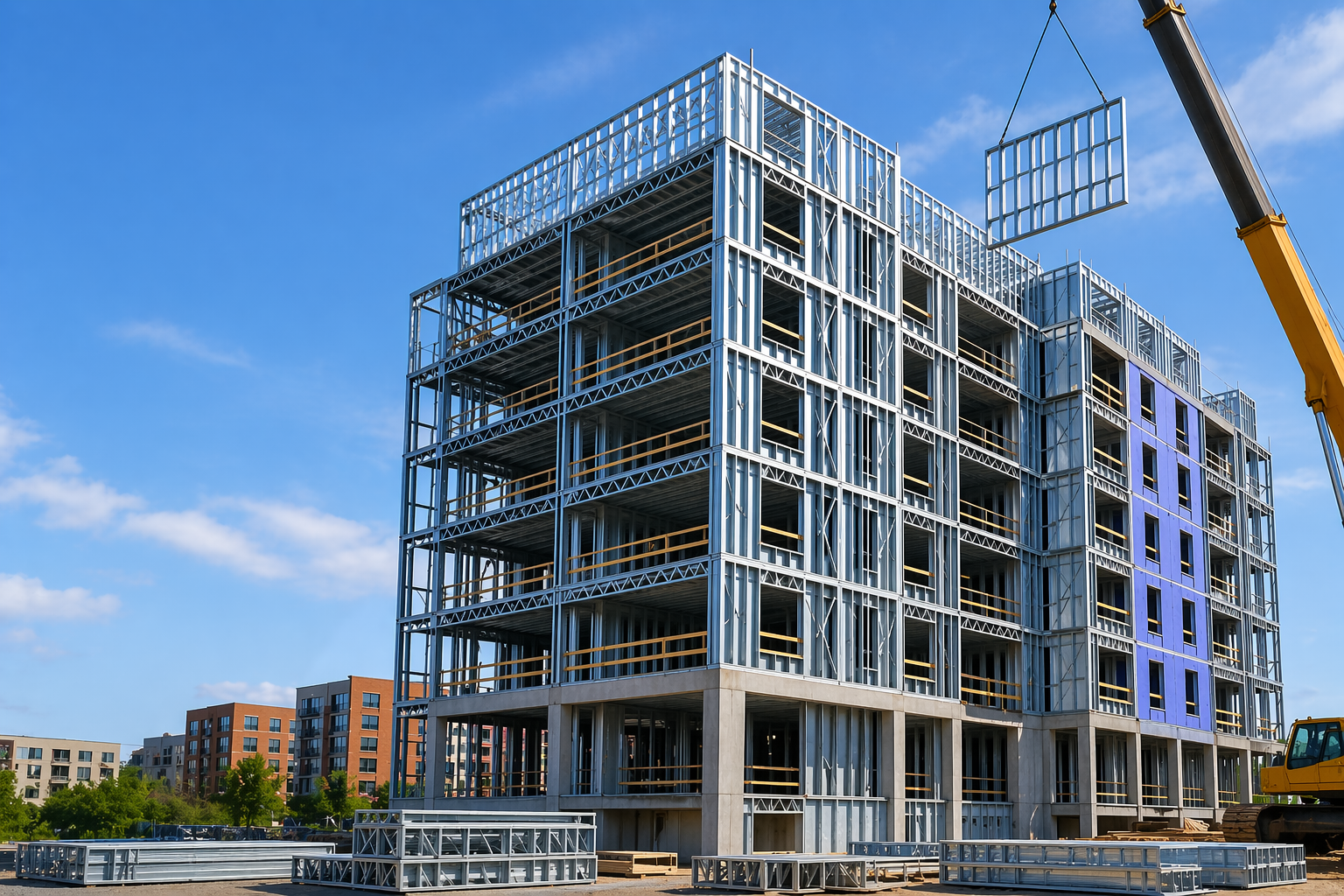
Introduction
“How many stories can you build with cold-formed steel?” sounds like a simple question, but on real projects it never is.
What teams are usually asking is something more practical: At what height does cold-formed steel still make structural and economic sense? When does it remain straightforward from a code and coordination standpoint? And when should the project shift to a hybrid system instead of trying to force a single framing approach across the entire building?
That distinction matters. Too many early conversations reduce cold-formed steel framing to a yes-or-no material decision. In reality, building height is shaped by a combination of code limits, fire-resistance requirements, structural loads, floor spans, lateral design, occupancy, and how disciplined the team is during design. The answer is not “always six,” “always ten,” or “always twelve.” The better answer is: it depends on the system, the jurisdiction, and how the building is engineered.
The Short Answer
In today’s market, cold-formed steel framing is commonly used very successfully in low-rise and mid-rise construction, and many teams view the 4- to 7-story range as a strong practical zone for load-bearing CFS on the right building types. At the same time, industry case studies show CFS being used in 9-story hotels, 10-story multifamily work, and even 12-story apartment applications. There are also examples of cold-formed steel being used in much taller buildings, but those are not the norm for most developers evaluating a repeatable project delivery strategy.
Just as important, BuildSteel notes that current building codes restrict certain CFS-framed structures to six stories or 65 feet in height, while industry research and testing are actively pushing beyond that benchmark. In other words, the technical ceiling and the routine code pathway are not always the same thing.
The Better Question: How Many Stories Make Sense for This Project?
For developers and design teams, story count should be evaluated through four filters.
1. Code path
Height is not controlled by steel alone. It is controlled by the full building system and the code path the project is taking. Construction type, occupancy, fire-resistance ratings, podium conditions, sprinkler assumptions, and jurisdictional interpretation all affect what is straightforward versus what requires more specialized engineering or alternate approvals. That is one reason broad claims about “CFS can go X stories” are often misleading.
2. Structural loads and spans
A compact hotel or apartment layout with repetitive units is very different from a building with long open spans, large amenity decks, heavy transfer conditions, or unusual floor-to-floor requirements. CFS tends to be strongest where the layout is repetitive, the spans are disciplined, and the structure can rely on distributed load-bearing walls rather than trying to create wide-open structural behavior everywhere. The 9-story hotel example from BuildSteel is a good illustration: the system worked because it was engineered carefully around the project’s geometry and floor-to-floor demands, while minimizing structural steel where possible rather than pretending it was unnecessary in every condition.
3. Lateral system demands
As buildings get taller, lateral forces become more important. The question stops being only about gravity loads and starts becoming about drift, shear walls, strap bracing, diaphragm behavior, and overall building movement. That is where some projects remain all-CFS, while others move toward hybrid strategies. Recent industry testing has focused specifically on showing that CFS systems can perform at greater heights, including 10-story seismic testing, but that does not eliminate the need for project-specific engineering judgment.
4. Delivery discipline
This is the one factor people underestimate. Cold-formed steel can go much higher than many assume, but the higher the building goes, the less tolerance there is for loose coordination. Openings, load paths, shaft walls, floor framing, fire-rated assemblies, façade attachment, and MEP penetrations all need to be resolved early. If the project team is still designing in the field, the theoretical height potential of the system becomes much less relevant.
Where Cold-Formed Steel Is Most Comfortable
For many developers, the most attractive range for cold-formed steel framing is low-rise to mid-rise residential and hospitality work: multifamily, hotels, student housing, senior living, and similar building types with repeated room layouts and controlled spans. That is also where off-site panelization can create meaningful schedule and quality advantages because the building geometry repeats and the framing can be manufactured with a high degree of consistency. Mainefactured’s own blog content already leans into this pattern across hotels, multifamily, and built-to-rent for a reason: the operational payoff tends to show up where repetition and coordination matter most.
This is why the discussion should not be framed as “Can cold-formed steel reach high-rise scale?” It should be framed as “Where does cold-formed steel outperform other systems with the least friction?” Those are not the same question.
When Hybrid Systems Start to Make More Sense
A lot of successful taller projects are not pure material stories. They are smart system stories.
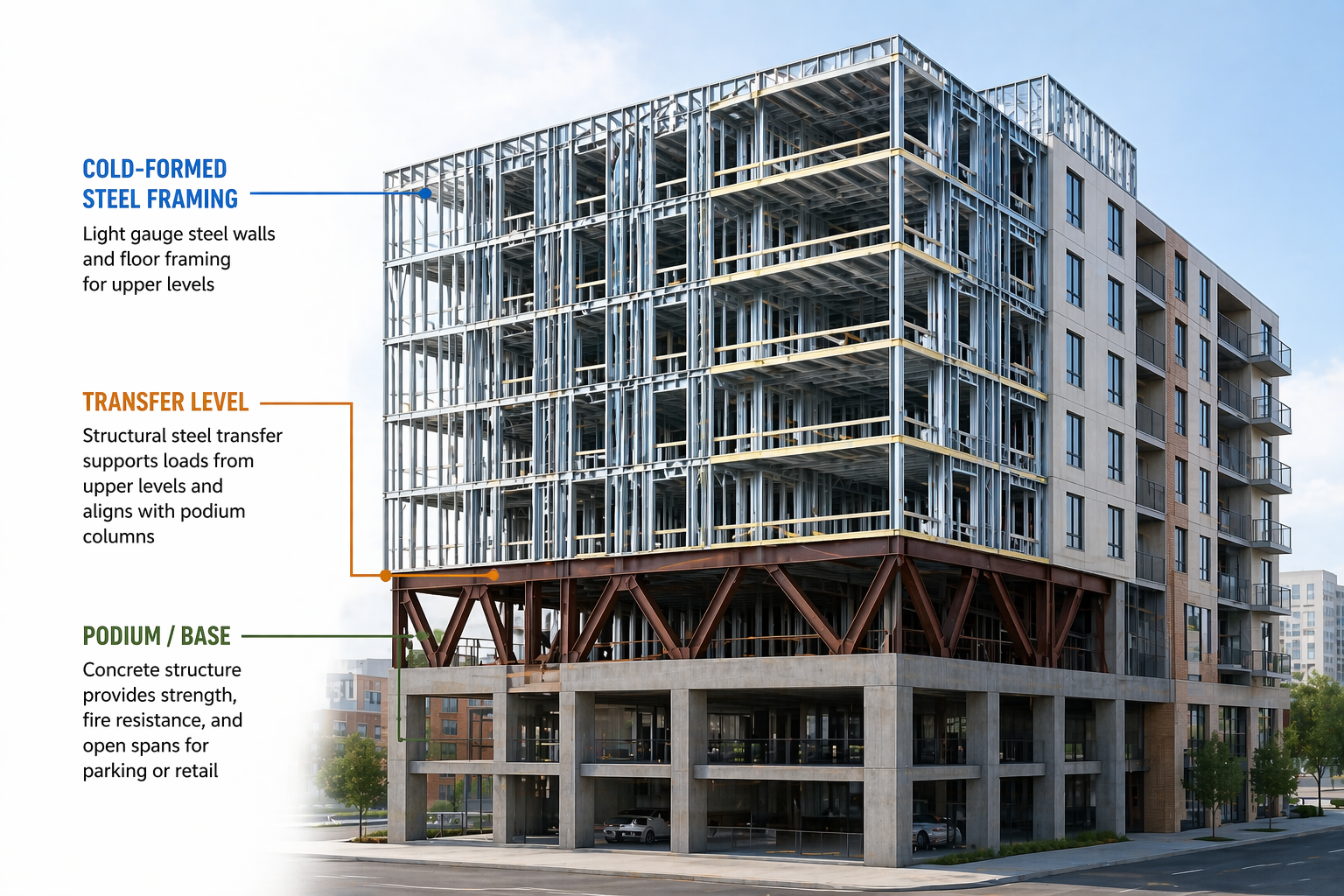
As story count increases, many teams use hybrid strategies: cold-formed steel for the majority of wall and floor framing, with selected structural steel or concrete elements where longer spans, transfers, podium conditions, or special loading make them more efficient. That approach often produces a better result than trying to force one system everywhere. It also reduces the risk of overdesigning the building just to preserve a cleaner narrative around a single material choice. The 9-story hotel and other featured case studies show exactly this kind of thinking: use CFS aggressively where it creates value, and supplement it where needed.
For owners, that usually leads to a better question in preconstruction: not “wood vs. metal” or “CFS vs. red iron,” but “What is the most efficient structural mix for this height, this plan, and this schedule?”
What Developers, Architects, and GCs Should Evaluate Early
Before locking in a target story count with cold-formed steel framing, teams should pressure-test the following:
Repetition and unit stack discipline
If the floor plates repeat cleanly and wet walls, shafts, and structural walls align well, CFS becomes more compelling.
Floor span expectations
The more the design depends on large open spans, the more likely hybrid framing becomes the better answer.
Podium and transfer conditions
A podium can be an efficient solution, but it changes the conversation. Teams should decide early whether the project is truly an all-CFS play above the podium or a broader hybrid structure.
Fire and acoustical assemblies
These do not automatically kill height feasibility, but they do affect wall thickness, coordination, shaft details, and inspection risk.
Jurisdiction and approval comfort
Some jurisdictions, plan reviewers, and inspection teams are simply more familiar with cold-formed steel than others. That does not change what is possible, but it can absolutely change how much friction a team faces getting there.
Manufacturing and installation strategy
A tall building framed in CFS without a disciplined panelization and sequencing plan can give back many of the advantages the system is supposed to create.
So, How Many Stories Can You Build?
The honest answer is this:
You can routinely build a meaningful range of low-rise and mid-rise projects with cold-formed steel framing, and the system is already proven in 7-, 9-, 10-, and 12-story examples. Industry organizations also point to projects exceeding 10 stories and even much taller edge-case applications. But for most developers and contractors, the practical question is not the outer limit of the material. It is where the system remains efficient, approvable, repeatable, and financially rational.
In many real-world projects, that means cold-formed steel is an excellent fit for the mid-rise zone and an increasingly viable option beyond it when the building is engineered correctly and the team is willing to resolve complexity upstream. Once the project starts stretching on spans, transfers, irregular geometry, or jurisdictional friction, hybrid systems often become the smarter move.
That may sound less absolute than some material marketing claims. But it is closer to how good projects are actually delivered.
Conclusion
Cold-formed steel framing can go higher than many people still assume. The industry has already demonstrated that clearly. But the best decision-makers do not anchor on the tallest possible example. They focus on where the system creates the most predictable value.
For developers, architects, and GCs, that usually means evaluating cold-formed steel not as a theoretical maximum-height material, but as a project delivery system. On the right building, with the right spans, code path, and coordination discipline, it can support far more vertical ambition than many teams realize. On the wrong building, or with the wrong expectations, it can be forced into roles that a hybrid strategy would handle better.
That is why the story-count question should be asked early, not late. By the time the structural concept is locked and the schedule is compressed, the best opportunities to use cold-formed steel intelligently are often already gone.
Related posts
SEE ALL POSTS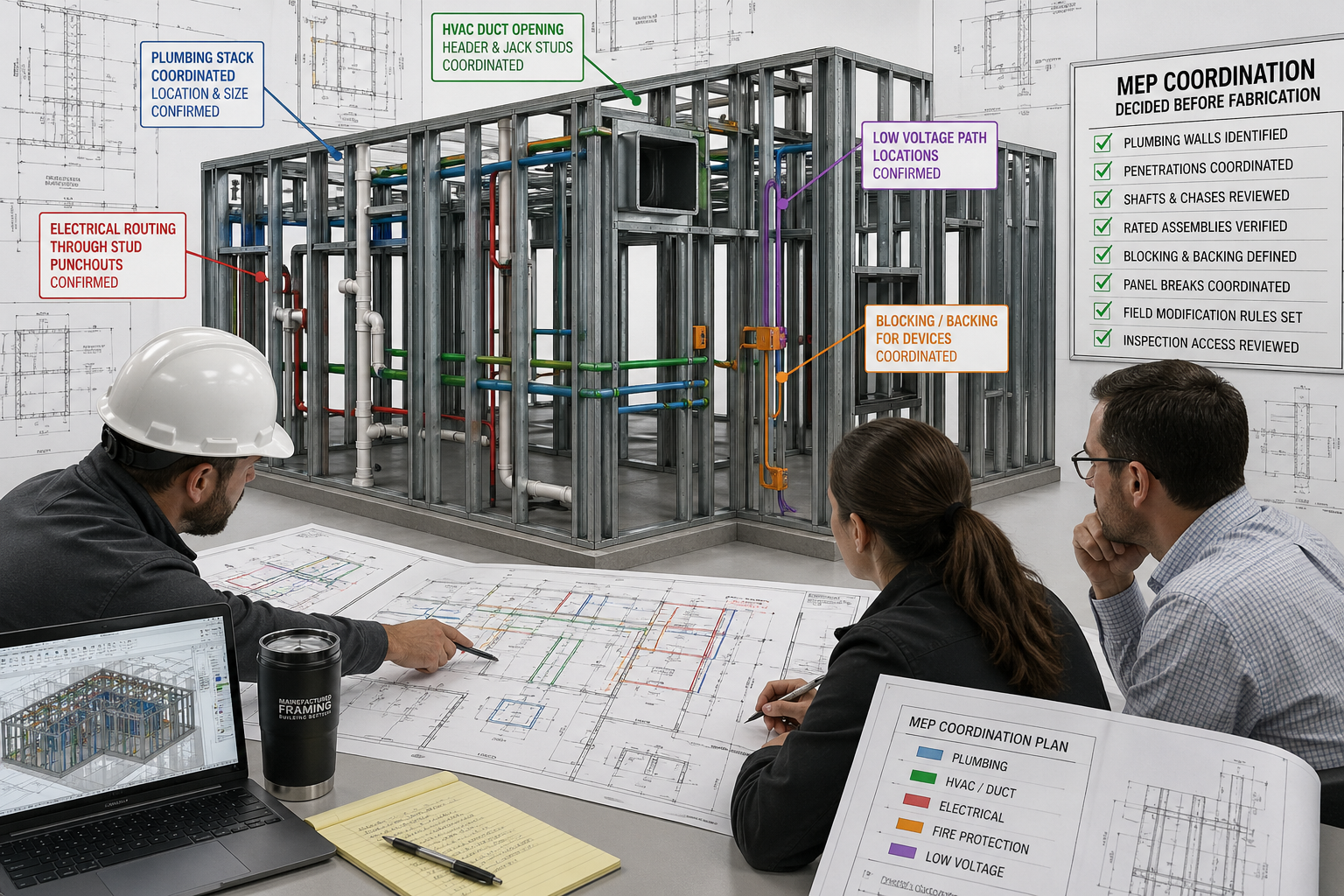
MEP Coordination in Panelized Cold-Formed Steel: What Must Be Decided Before Fabrication
Cold-Formed Steel for Custom Homes: What High-End Builders Need to Know