Cold-Formed Steel Framing in Mixed-Use & Multi-Story Projects: What Developers Need to Know in 2026
Introduction
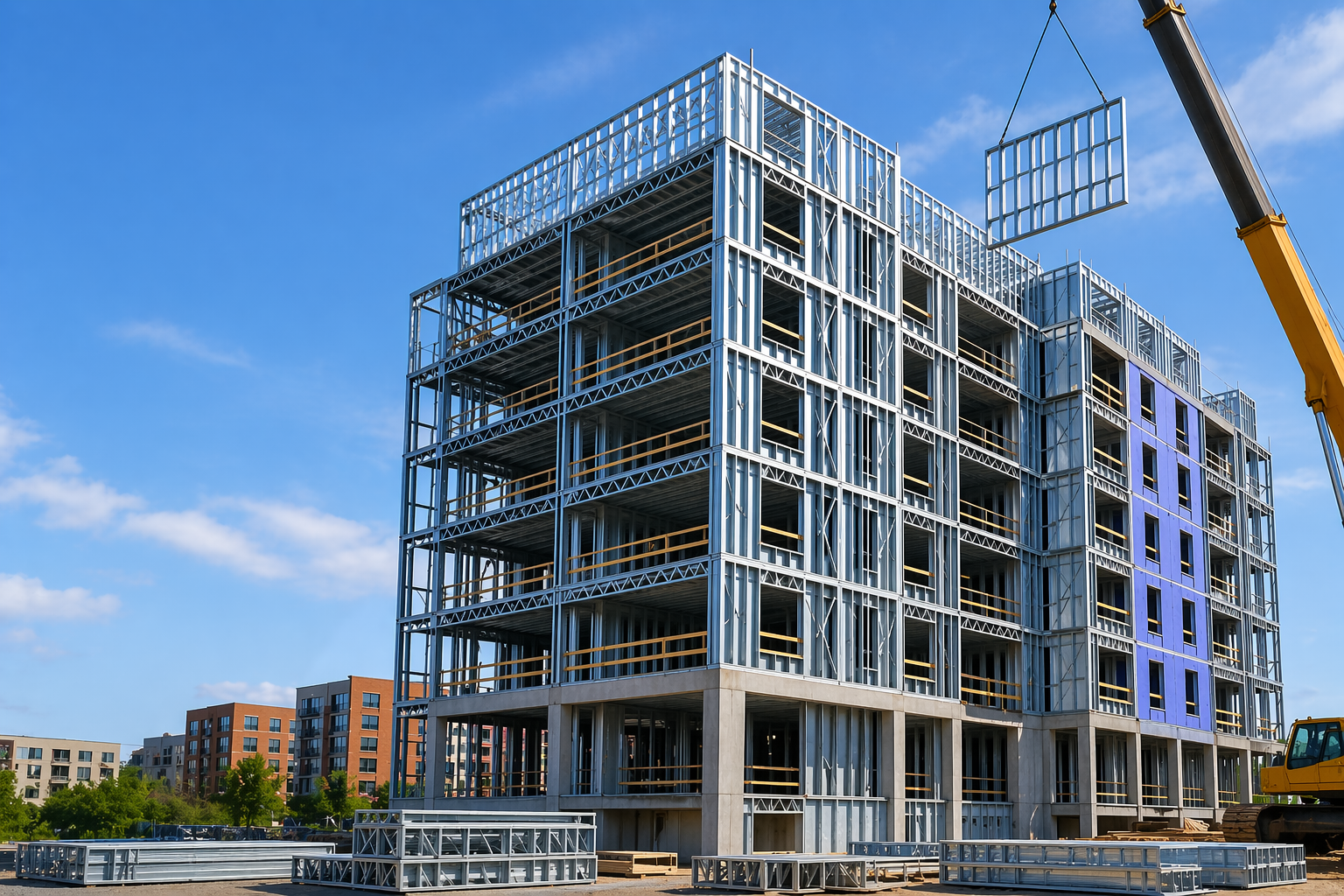
Across the country, mid-rise mixed-use development continues to grow, driven by demand for walkable neighborhoods, housing density, and ground-floor retail that supports vibrant urban corridors. These buildings are more complex than traditional multifamily or light commercial work, and today’s developers are increasingly focused on one thing above all else: how to frame 4–8 story buildings faster, safer, and with dramatically less risk.
Cold-formed steel (CFS) has historically been treated as a “light commercial” alternative to wood. But in 2025–2026, a notable shift is underway. Developers are moving away from wood — and even away from structural steel — because panelized CFS is proving to be the most reliable path to schedule compression, predictable performance, and stronger lender confidence. Material cost plays a role, but it is no longer the deciding factor.
Panelized cold-formed steel has quietly become the preferred system for mid-rise mixed-use buildings, not as an alternative, but as the new standard.
Why Mixed-Use & Mid-Rise Buildings Are Outgrowing Wood Framing
Fire, Density & Code Limitations
Mixed-use buildings combine structural demands that push wood to its limits: retail spans on the ground floor, parking podiums beneath residential floors, and varying occupancy types stacked vertically. These configurations expose the weaknesses of wood construction — especially shrinkage, fire ratings, and alignment between floors.
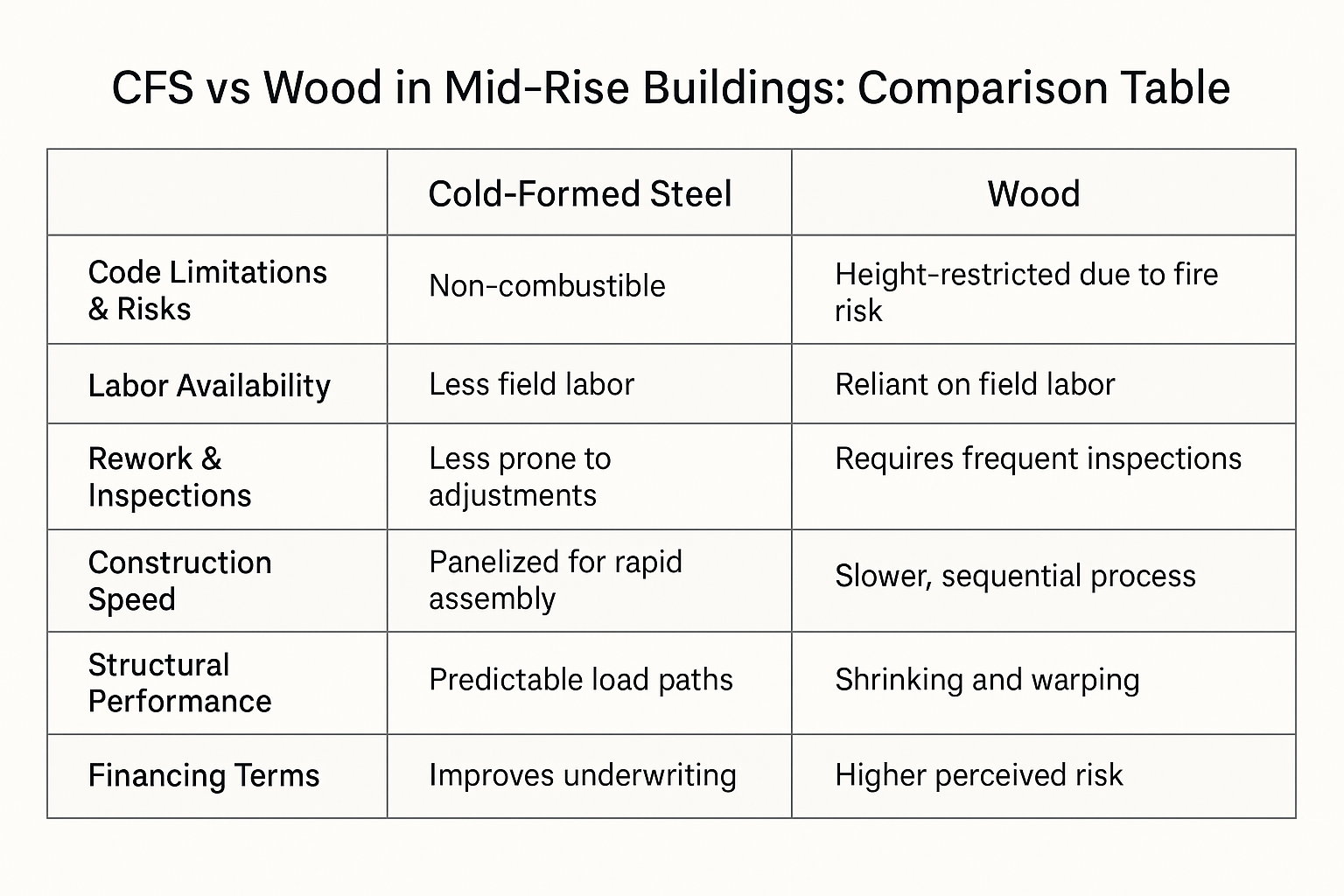
Wood can work up to a point, but codes become more restrictive as the building grows taller. Shrinkage introduces façade and storefront alignment issues, and achieving required fire ratings becomes increasingly complicated. CFS provides stable, non-combustible framing that avoids these issues entirely, making it a safer and more predictable choice for buildings that push beyond three or four stories.
Labor Shortages in Framing Trades
Another constraint is labor. Stick-built wood framing requires large, highly skilled crews capable of coordinating dozens of framing inspections and field adjustments. But the labor pool is shrinking, and the variability between subcontractors can significantly impact schedule and quality.
Mid-rise buildings amplify these risks: more levels, more inspections, and greater exposure to delays. Panelized CFS reduces the on-site labor burden by moving the complexity to a controlled manufacturing environment.
Cost of Rework & Delays
Wood’s susceptibility to warping, twisting, and moisture affects both schedule and budget. These issues lead to frequent rework, additional inspections, and costly on-site adjustments — all of which compound as the building grows taller.
Mixed-use projects operate in tight urban footprints, where rework is disruptive and expensive. The more predictable behavior of cold-formed steel reduces these variables and helps teams maintain schedule discipline.
Why Panelized Cold-Formed Steel Is Now Winning
Schedule Compression: The Developer’s #1 Priority
In mid-rise construction, the value of predictable speed has surpassed the value of cheaper materials. Panelized CFS consistently installs 30–50% faster than stick-built systems because the work is completed in parallel: engineering and fabrication happen off-site while foundations and podium levels are underway. Once panels arrive, crews can rapidly assemble floors with far fewer delays from inspections or weather.
This has cascading benefits: earlier dry-in, earlier MEP rough-in, faster façade installation, and earlier occupancy. In a market where interest carry and general conditions accumulate daily, this compression is often the strongest financial argument for CFS.
Lower Risk Exposure & Higher Predictability
Developers are gravitating toward systems with fewer unknowns. Factory-built CFS panels deliver precise dimensions, consistent tolerances, and predictable structural performance. There is no shrinkage, no warping, no risk of mold, and no surprises when it’s time to install windows, doors, or MEP penetrations.
That predictability reduces exposure across inspections, labor coordination, change orders, and rework — areas where wood-framed projects often struggle as complexity increases.
Lender & Insurer Advantages
Financing is another area where panelized CFS performs well. Banks and insurers increasingly favor steel framing because it reduces fire risk, limits the potential for rework, and creates a more predictable construction timeline. This leads to more confidence in underwriting and can translate into improved lending terms or more favorable insurance conditions.
For mixed-use projects operating on tight pro forma margins, this financial reliability matters.
How Panelized CFS Solves the Mixed-Use “Podium Problem”
Mixed-use buildings frequently include a structural podium — whether concrete or structural steel — below several levels of residential units. Transitioning from a stiff podium to a material like wood introduces differential movement, lateral load challenges, and complications in coordinating storefronts and mechanical systems.
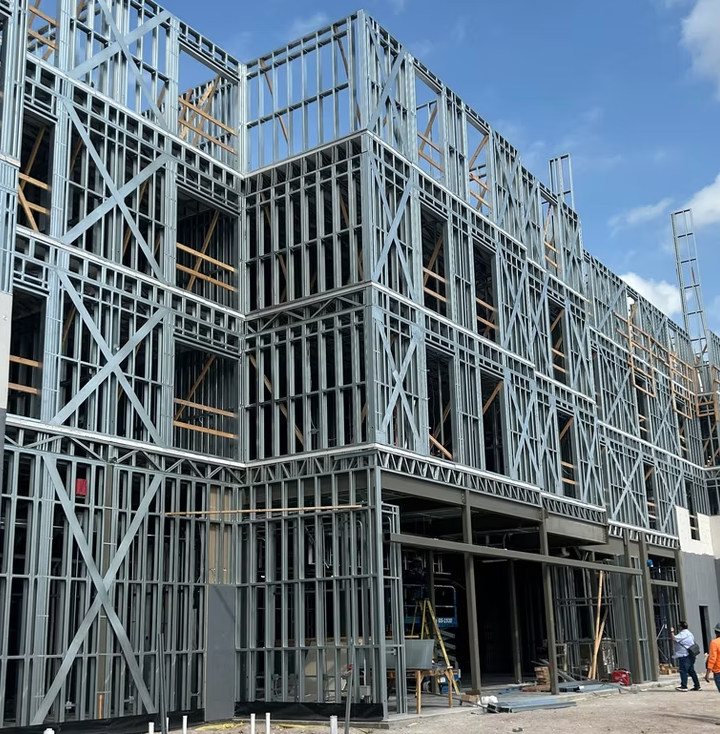
Panelized CFS integrates cleanly with podium slabs. Because CFS does not shrink or settle, it aligns with the geometry of the podium and supports precise load path transfer. Large retail openings can be accommodated alongside dense residential layouts above, without forcing architects into compromises on window placement or unit design.
For 4–8 story buildings, this balance of density, stiffness, and predictability is difficult to achieve with wood.
Cost Breakdown: More Than Material Cost
The conversation about wood vs. steel often centers on comparing unit prices. But developers who shift to panelized CFS do so because of total project cost — not just the direct cost of studs or sheathing.
Labor Reduction
Panelized steel requires fewer framers on site, reducing both labor costs and the risk of schedule disruptions. Crews spend more time assembling and less time measuring, cutting, and reworking surfaces affected by moisture or movement.
Waste Reduction
Factory fabrication optimizes every piece of material, reducing scrap and minimizing disposal costs. Waste on a panelized project is measured in handfuls, not dumpsters.
Faster Dry-In & Earlier Revenue
With floors stacked quickly and exterior sheathing installed soon after, buildings achieve dry-in significantly earlier. This accelerates MEP rough-in, interior work, and ultimately occupancy — a major financial advantage in mixed-use developments.
Lower GC Overhead
A shorter schedule directly reduces general conditions: fewer supervisory days, fewer weeks of site logistics, less equipment rental time, and less risk from weather exposure.
Less Rework & Tighter Tolerances
Because CFS does not move once installed, windows fit as designed, doors hang properly, drywall stays flat, and finishes remain aligned. This greatly reduces punch lists and warranty-related callbacks.
Design Flexibility for Architects
Cold-formed steel is often misunderstood as rigid or limiting, but in practice it increases design flexibility. Large window openings, retail storefront assemblies, and long-span floor trusses are easier to incorporate with engineered CFS than with wood.
Architects gain confidence in predictable load paths, consistent wall thicknesses, and minimal movement over time — all critical for mixed-use buildings that pair large commercial openings with stacked residential units.
Balconies, cantilevers, mechanical chases, and complex unit layouts are easier to execute because dimensional tolerances remain consistent from the first floor to the top floor.
Real-World Example: A 6-Story Mixed-Use Building
Consider a typical 6-story mixed-use building: ground-floor retail, two levels of parking, and several levels of multifamily units stacked on top. Using stick-built wood framing, the superstructure may require 16 weeks of sequential work, repeated inspections, and constant adjustments.
Shifting to panelized CFS reduces that timeline to roughly eight weeks. Panels are fabricated while foundations and podiums are being built, then installed rapidly with minimal interruption. The building reaches dry-in sooner, the MEP trades mobilize earlier, and occupancy accelerates — a schedule impact that outweighs any small differences in material costs.
How Panelization Works
The process itself is straightforward. Architectural plans are translated into engineered shop drawings and BIM models. Every wall panel is designed, cut, and assembled in a controlled manufacturing environment.
Once delivered to the site, each panel is labeled, craned into position, and installed in a predictable sequence. Entire floors can be stood within days, not weeks. This shift — from field-built uncertainty to manufacturing precision — is what makes panelized CFS so compelling for mid-rise work.
Conclusion
Developers are not choosing cold-formed steel because it is trendy or because it always costs less per unit of material. They are choosing it because panelized CFS provides a clearer, safer, and more predictable path to completing mixed-use buildings on time and on budget.
Schedule certainty, reduced risk exposure, better lender alignment, design flexibility, and cleaner integration with podium structures all position panelized cold-formed steel as the logical choice for 4–8 story projects in 2026 and beyond.
Companies like Mainefactured Framing specialize in engineering-driven CFS panelization systems built specifically for this type of work — but the reason developers adopt the system is simple: it makes the entire development more predictable.
Related posts
SEE ALL POSTS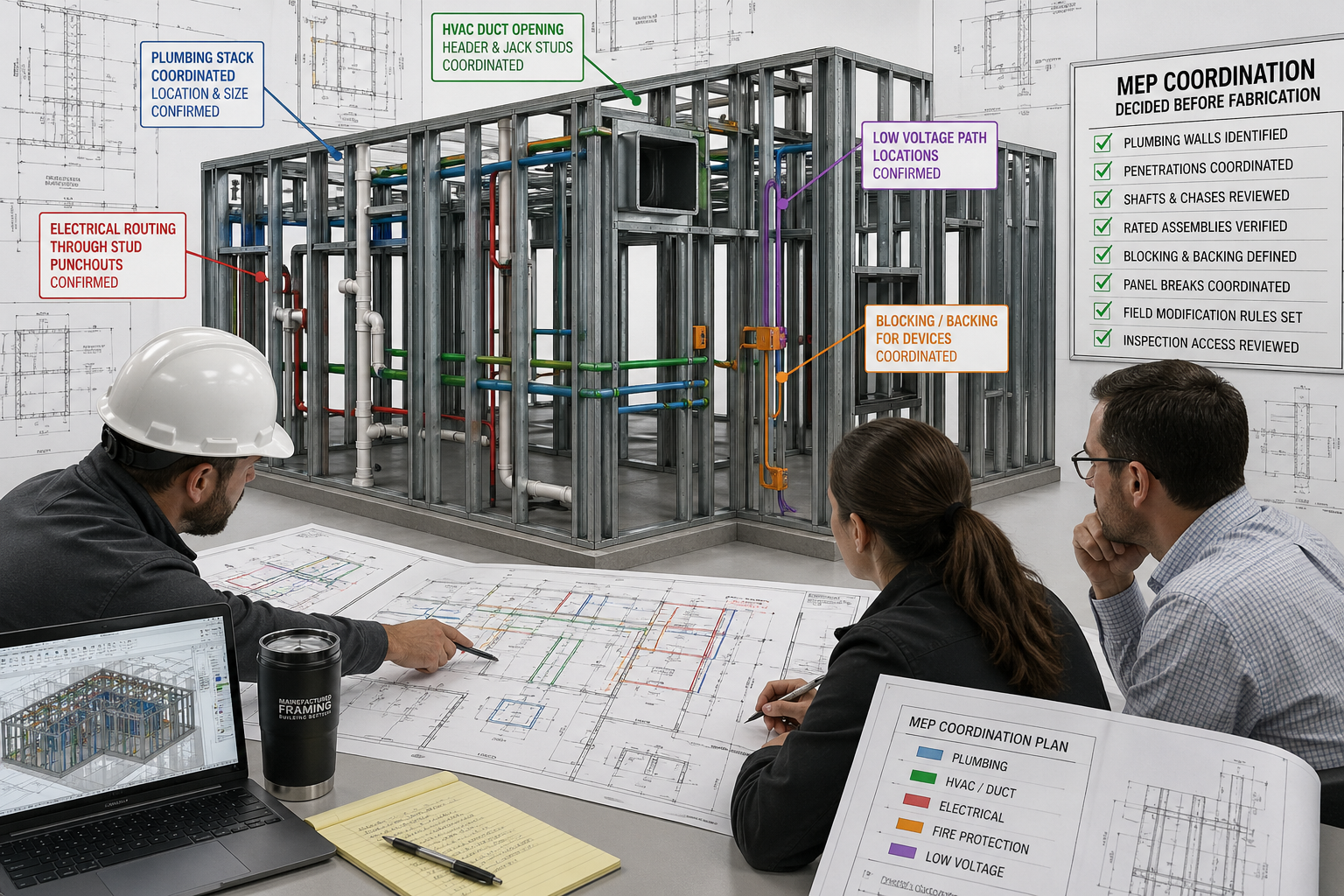
MEP Coordination in Panelized Cold-Formed Steel: What Must Be Decided Before Fabrication
Cold-Formed Steel for Custom Homes: What High-End Builders Need to Know