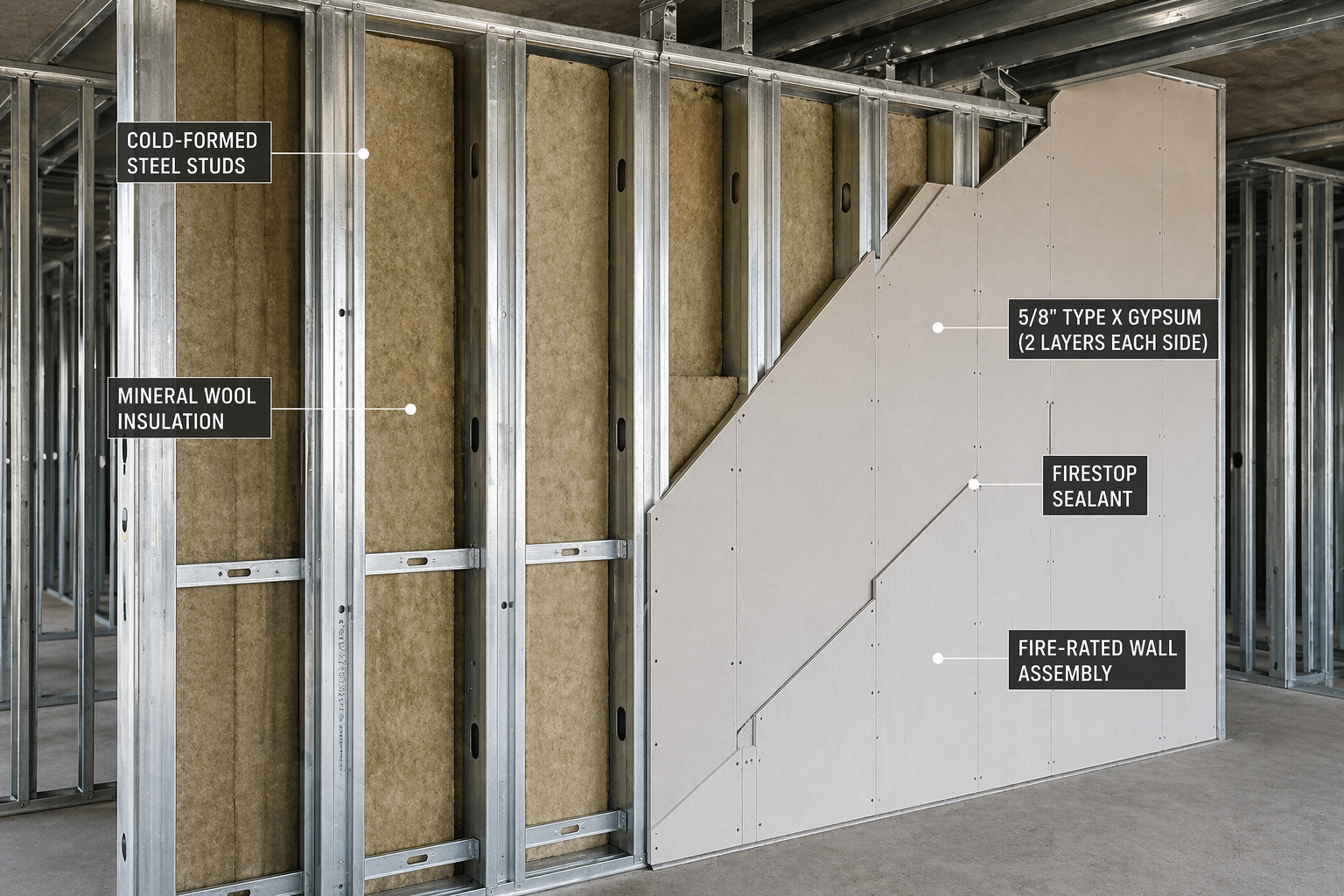
Panelized Metal Framing in Cold Weather: Why It Performs When Other Systems Struggle
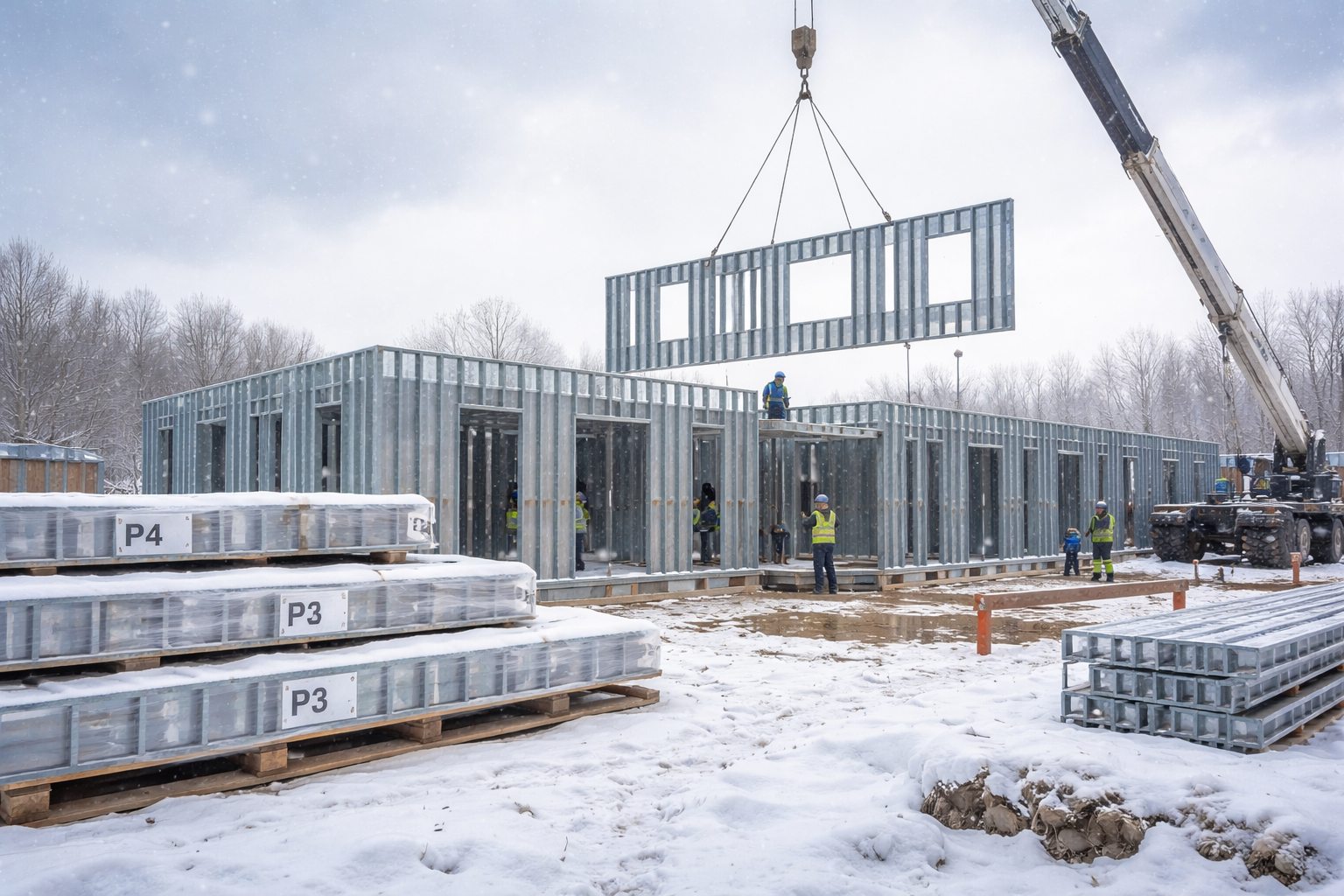
Winter Is Where Framing Systems Get Exposed
Cold weather doesn’t just slow construction.
It reveals which framing systems were built for predictability—and which ones rely on ideal conditions to stay on schedule.
When temperatures drop, traditional framing methods experience compounding issues:
- Labor productivity declines
- Material handling becomes inconsistent
- Moisture exposure increases
- Schedule buffers disappear
For developers and general contractors building in cold or variable climates, winter framing is often treated as an unavoidable risk. Panelized metal framing approaches the problem differently by removing weather dependency from the critical path.
Why Traditional Framing Struggles in Cold Conditions
Most conventional framing systems—particularly stick-built wood—are heavily dependent on continuous on-site labor and favorable weather windows.
In cold environments, this creates several structural disadvantages.
1. Productivity Loss Is Immediate
Cold temperatures slow manual tasks:
- Handling dimensional lumber becomes harder as moisture freezes
- Fasteners and adhesives lose performance
- Crews require more breaks and shorter workdays
Even when crews are present, output drops. The schedule impact compounds daily.
2. Material Exposure Becomes a Quality Risk
Wood framing is vulnerable to:
- Snow accumulation
- Freeze-thaw cycles
- Trapped moisture inside wall assemblies
Once moisture is introduced during framing, it is difficult to fully remove—especially when enclosure is delayed by weather.
3. On-Site Sequencing Breaks Down
Cold weather disrupts the normal flow of:
- Framing
- Sheathing
- Weather barrier installation
Missed days force resequencing, stacking trades on top of each other once weather improves. That congestion increases error rates and rework.
Panelized Metal Framing Changes the Winter Equation
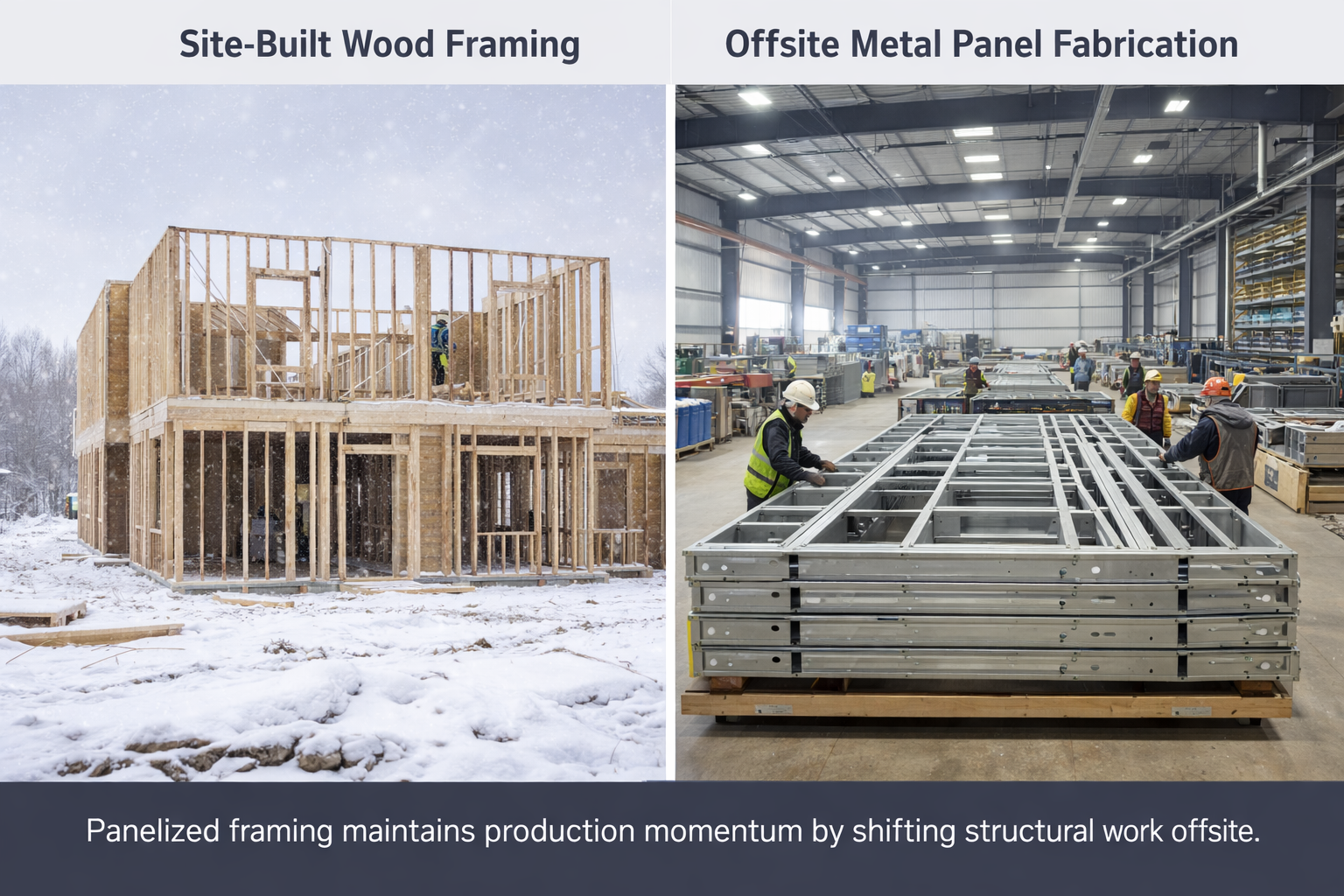
Panelized metal framing performs differently because most of the work does not happen on the jobsite.
Instead of building the structure piece-by-piece in the cold, panelized systems shift complexity upstream.
1. Offsite Fabrication Removes Weather Dependency
Panelized wall and floor systems are:
- Manufactured indoors
- Assembled under controlled conditions
- Inspected before delivery
Cold temperatures, wind, and precipitation do not affect framing production. While site work may pause, framing continues in parallel.
This is the fundamental difference: winter becomes a logistics issue, not a productivity issue.
2. Installation Windows Shrink—But That’s Enough
Cold weather reduces workable installation days. Panelized framing is designed around that constraint.
Instead of needing:
- Weeks of continuous framing labor
Panelized systems require:
- Short, controlled installation windows
- Fewer crew days
- Less exposure time
A structure can be set, braced, and dried-in rapidly—even between storms.
This matters in regions where winter conditions are unpredictable rather than constant.
3. Metal Framing Is Dimensionally Stable in Cold
Cold-formed steel does not:
- Absorb moisture
- Warp due to freeze-thaw cycles
- Change dimensions with humidity
Tolerances remain consistent from fabrication through installation. Alignment, plumbness, and structural geometry are not compromised by temperature swings.
That dimensional stability becomes especially important when winter delays push enclosure later into the season.
Moisture Control Is the Hidden Advantage
Cold weather construction is not only about temperature—it’s about moisture management.
Panelized metal framing improves moisture control in three ways:
1. Reduced Exposure Time
Panels arrive ready for installation. Walls are not left partially framed and uncovered for days or weeks.
2. Faster Dry-In
The structure reaches weather-tight conditions sooner, limiting moisture intrusion during the most vulnerable phase of construction.
3. No Absorption Risk
Unlike wood, steel framing does not trap moisture internally, reducing long-term durability and indoor air quality risks.
Labor Availability Becomes Less Critical
Cold weather exacerbates labor shortages. Fewer workers are willing to frame outdoors in winter conditions, and turnover increases.
Panelized framing mitigates this by:
- Reducing on-site labor hours
- Simplifying installation tasks
- Shifting skilled work to controlled manufacturing environments
Projects rely less on finding large framing crews willing to work in winter and more on predictable installation teams.
Schedule Risk: Where Panelization Delivers the Most Value
Cold weather doesn’t usually increase framing costs directly—it increases uncertainty.
Developers feel that uncertainty in:
- Carrying costs
- Financing exposure
- Delayed revenue
Panelized metal framing reduces winter schedule risk by:
- Allowing parallel progress between site work and framing
- Shortening framing duration on site
- Creating predictable installation sequences
Rather than planning around weather delays, teams plan around known delivery and set dates.
Where Panelized Framing Performs Best in Cold Climates
Panelized metal framing is particularly effective for:
These project types benefit most because schedule compression and risk reduction outweigh material cost comparisons.
Cold Weather Construction Is a Systems Problem
Winter exposes weak systems.
It rewards methods that reduce dependence on field conditions.
Panelized metal framing does not eliminate winter—it removes winter from the most fragile part of the schedule. By shifting work offsite, stabilizing quality, and compressing on-site duration, it allows projects to move forward when traditional framing methods stall.
For teams building in cold or variable climates, that reliability is not a convenience.
It is a strategic advantage.
Related posts
SEE ALL POSTS
Sound-Rated Wall and Floor Assemblies for Cold-Formed Steel in Multifamily and Hotels

Exterior Wall Assemblies with Cold-Formed Steel: Sheathing, WRB, Insulation, and Cladding Coordination