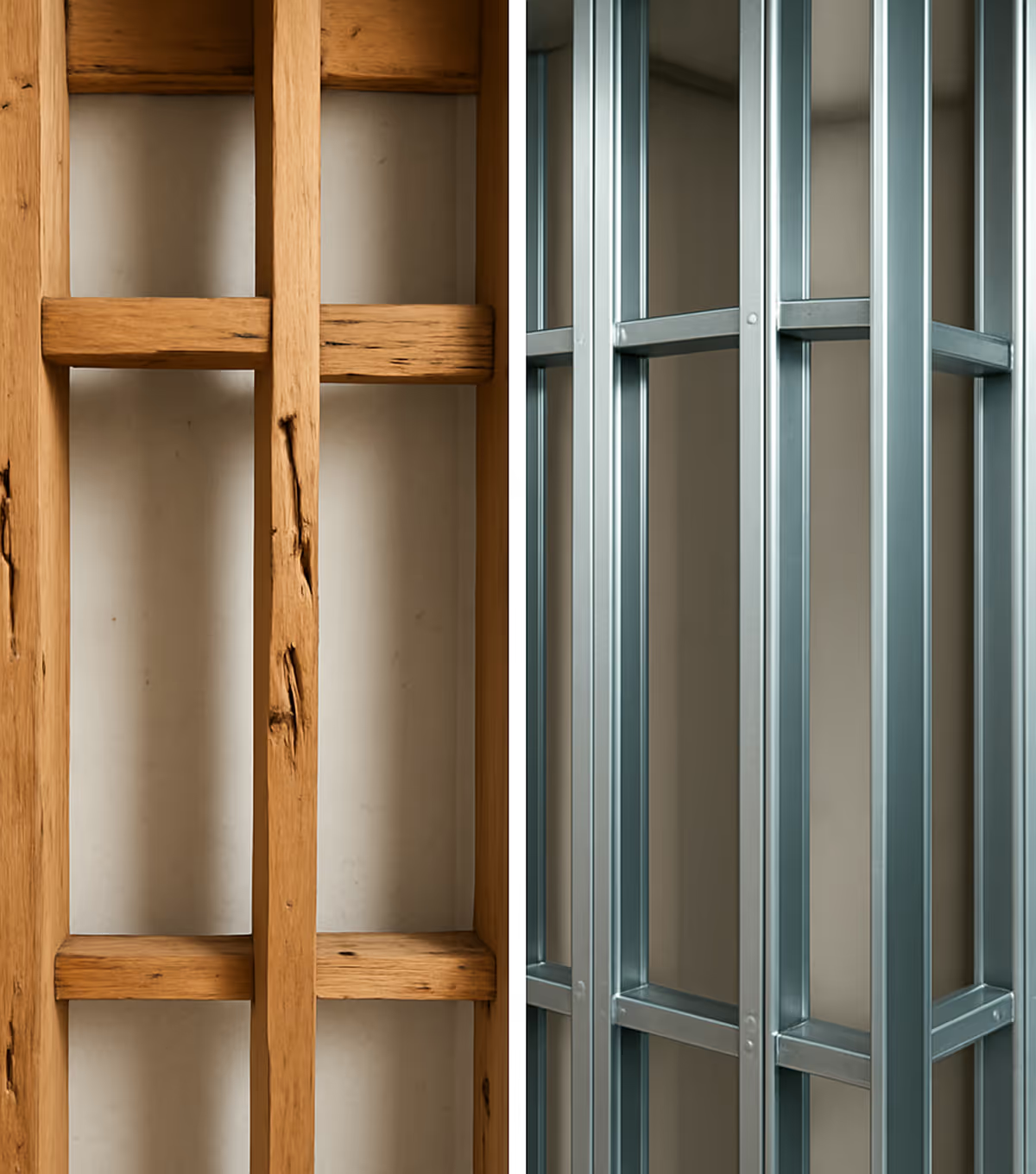
How Cold Formed Steel Framing Can Improve NOI and Asset Value Before a Project Is Even Built

Framing Decisions Do Not Stop at the Construction Budget
Most developers evaluate framing through the lens of first cost.
That is understandable. Framing is a visible line item, and early budgets often force teams to compare wood, concrete, structural steel, masonry, and cold formed steel framing on a direct cost basis. But that approach can miss a larger financial question:
What does the framing system do to the income statement, the balance sheet, and the capital stack?
For income-producing assets such as hotels, multifamily properties, built-to-rent communities, and senior living facilities, framing is not only a construction input. It can affect schedule certainty, stabilization timing, insurance assumptions, maintenance exposure, pest risk, fire-conscious design, long-term durability, and lender perception.
Those factors can influence net operating income, asset value, debt service coverage, leverage, and investor returns.
Panelized cold formed steel framing does not automatically improve every project. It requires early coordination, disciplined drawings, and a project team willing to make framing decisions before fabrication. But when the asset type depends on repeatability, speed, durability, and operational predictability, the financial impact can extend well beyond the framing line item.
Why NOI Is the Better Lens for Evaluating Framing
Net operating income, or NOI, is the income a property generates after operating expenses but before debt service, taxes, depreciation, and capital structure effects.
For stabilized income-producing real estate, NOI is central because asset value is often tied to a capitalization rate.
At a simple level:
Asset Value = NOI ÷ Cap Rate
That means a relatively modest improvement in NOI can create a meaningful increase in asset value.
For example, if a property improves annual NOI by $100,000 and the market cap rate is 6%, that incremental income could support roughly $1.67 million in additional asset value.
This is why construction decisions should not be evaluated only by what they cost. They should also be evaluated by what they may improve, reduce, protect, or accelerate over the life of the asset.
Cold formed steel framing can influence NOI in several ways:
The key is not that framing alone determines NOI. It does not. The point is that framing affects multiple variables that contribute to the operating and financial performance of the asset.

Faster Stabilization Can Improve NOI Before Operations Begin
For income-producing real estate, time is not neutral.
Every month a hotel, apartment building, senior living facility, or BTR phase remains unfinished is a month without operating income. It is also a month of continued interest carry, general conditions, insurance, taxes, supervision, and opportunity cost.
This is where panelized cold formed steel framing can create an immediate financial advantage.
Unlike conventional site-built framing, panelized systems allow much of the framing logic to be resolved before materials arrive on site. Wall panels, floor systems, trusses, openings, bearing conditions, and many coordination details are converted into a fabrication package. When the system is designed correctly, field crews are assembling a pre-planned framing system instead of creating the system piece by piece in the field.
That matters because schedule compression can influence:
- When units become leasable
- When hotel rooms become revenue-producing
- When senior living beds become available
- When BTR phases can be turned over
- When permanent financing or refinancing can occur
- When the asset can reach stabilization
For a hotel, earlier opening can mean earlier room revenue, food and beverage revenue, event revenue, and brand ramp-up. For multifamily, it can mean earlier lease-up. For BTR, it can mean faster absorption across repeatable phases. For senior living, it can mean earlier resident move-ins and earlier operating income.
The financial benefit is not simply “saving time.” It is pulling revenue forward.
That can affect NOI in the first operating year, reduce interest carry, and improve the developer’s ability to hit business plan milestones.
Insurance, Fire Risk, and the Operating Expense Side of the Equation
Insurance has become a more important construction and operating concern across many asset classes. Owners are paying closer attention to fire risk, builder’s risk coverage, long-term property insurance, and the difference between combustible and noncombustible assemblies.
Cold formed steel framing is noncombustible. That does not mean the entire building is noncombustible by default, and it does not eliminate the need for tested assemblies, firestopping, code compliance, and proper detailing. However, it can support a more fire-conscious design strategy when compared with wood framing.
For hotels, multifamily buildings, senior living facilities, and BTR communities, this can matter during both construction and operations.
During construction, fire events can be especially damaging because buildings may not yet have completed fire protection systems, compartmentalization, or final life safety measures in place. Reducing combustible framing material can help reduce one category of risk.
During operations, noncombustible framing may support stronger insurance conversations, especially when combined with other fire-conscious assemblies such as gypsum, mineral wool, metal roof systems, noncombustible exterior details, or fire-rated wall and floor assemblies.
Insurance outcomes vary by project, location, carrier, construction type, claims history, and the full building assembly. But from a developer’s perspective, even modest operating expense improvements can matter because reduced operating expenses can increase NOI.
And when NOI increases, asset value may increase with it.
The Maintenance Advantage: Steel Does Not Behave Like Wood
Operating expenses are not limited to utilities, staffing, taxes, and insurance. Maintenance and repair exposure also affect long-term NOI.
Wood framing can be a proven and familiar system, but it is still an organic material. It can shrink, swell, warp, rot, absorb moisture, and attract termites or other pests. Those risks vary by geography, building type, detailing quality, and operating conditions, but they are not theoretical.
Cold formed steel framing behaves differently.
Steel does not rot. It does not feed termites. It does not shrink as it dries. It does not warp in the same way dimensional lumber can. It provides dimensional stability that can benefit downstream finishes and long-term building performance.
For income-producing properties, this can reduce friction in several areas:
For senior living facilities, reduced maintenance disruption is especially important because repairs can affect resident comfort and operations. For hotels, maintenance issues can remove rooms from inventory. For multifamily and BTR owners, recurring repair issues can affect resident satisfaction, turnover, and operating costs.
The impact may not always appear in the initial construction estimate. But it can appear later in the asset’s operating performance.

DSCR: The Hidden Benefit of Improving NOI Upfront
One of the most overlooked benefits of improving NOI is its effect on debt service coverage ratio, or DSCR.
DSCR measures the relationship between a property’s net operating income and its debt service. Lenders use it to evaluate whether the asset produces enough income to cover loan payments.
At a simple level:
DSCR = NOI ÷ Annual Debt Service
A higher NOI can create a stronger DSCR. That matters because DSCR can influence how much debt a lender is willing to provide.
This is where the hidden leverage effect becomes important.
If a framing system contributes to better projected NOI through faster stabilization, lower operating expenses, reduced insurance exposure, lower maintenance assumptions, or reduced risk, the project may present a stronger coverage profile.
A stronger DSCR may support:
- Higher loan proceeds
- Better refinancing outcomes
- Lower perceived risk
- More flexible capital structure
- Higher return on equity
- Improved investor confidence
This does not mean a lender will automatically increase leverage because a project uses panelized cold formed steel framing. Lenders look at many factors, including market rents, occupancy, borrower strength, guarantees, reserves, interest rates, operating history, and appraised value.
But the financial logic is important.
If NOI improves, DSCR improves.
If DSCR improves, borrowing capacity may improve.
If borrowing capacity improves, equity requirements may decrease.
If less equity is required, overall project returns may improve.
That is why developers should evaluate framing as part of the broader capital strategy, not just as a construction cost.
Asset Value Impact: Small NOI Improvements Can Create Large Valuation Changes
The relationship between NOI and asset value is one of the strongest arguments for looking beyond first cost.
Consider a property valued at a 6% cap rate.
This is why operating expense reduction and faster income generation matter.
A framing system does not need to transform the entire project budget to create value. It only needs to improve enough operational variables to support stronger NOI, lower risk, or faster stabilization.
That value can show up in several moments:
- During construction, through reduced schedule risk and potentially lower carry costs.
- At opening or lease-up, through earlier revenue generation.
- At stabilization, through improved NOI and stronger DSCR.
- At refinance, through stronger income and potentially better debt proceeds.
- At sale, through higher valuation if NOI is improved and the market supports the cap rate.
For developers and sponsors, this is where the conversation changes.
The question is no longer, “Is cold formed steel framing cheaper than wood?”
The better question is, “Does this framing strategy improve the total economics of the asset?”
Why Hotels Benefit from NOI-Focused Framing Decisions
Hotels are highly sensitive to opening dates.
A delayed opening can affect room revenue, brand ramp-up, staffing plans, pre-booked events, financing timelines, and investor expectations. Hotel developers also face unique pressure around fire safety, insurance, repeatable room layouts, MEP coordination, and finish consistency.
Panelized cold formed steel framing can be especially relevant for hotels because many hotel designs are repetitive. Guestroom stacks, corridors, demising walls, bathroom walls, shaft conditions, and roof/floor systems often repeat across floors.
That repetition supports panelization.
When framing is resolved earlier, the project team can reduce field variability and improve the likelihood of clean execution. For a hotel, the financial benefit can come from earlier dry-in, faster room turnover to finish trades, reduced rework, and a more predictable path to opening.
The NOI impact is straightforward: earlier opening and lower operating risk can improve the asset’s income profile.
Multifamily: Value Comes from Speed, Repeatability, and Reduced Operating Friction
Multifamily developers often operate in tight pro formas. Rent growth, cap rates, interest rates, taxes, insurance, and construction costs all affect feasibility.
Because of that, framing is frequently evaluated on lowest first cost. But for larger multifamily projects, especially those with repeated unit types, corridors, demising walls, and stacked layouts, panelized cold formed steel framing can influence both schedule and long-term operations.
Potential benefits include:
- Faster framing cycles
- Reduced dimensional variability
- Cleaner MEP coordination
- Better finish trade productivity
- Reduced maintenance exposure
- Reduced pest-related concerns
- Stronger fire-conscious assembly strategy
For multifamily owners, the economic value may come from reducing execution risk during construction and reducing recurring operational friction after stabilization.
In a cap-rate-driven valuation model, even modest NOI gains can become meaningful.
BTR Communities: Repetition Changes the Economics
Built-to-rent communities are one of the clearest examples of why framing should be evaluated as a system.
A one-off custom building has limited repetition. A BTR community may have dozens or hundreds of repeatable units, repeated elevations, repeated wall panels, repeated roof trusses, repeated openings, and repeated MEP conditions.
That repetition changes the value of upstream coordination.
When a panelized cold formed steel framing system is designed correctly, the same logic can be repeated across units and phases. This can reduce learning curves, improve consistency, and help teams avoid solving the same framing problems over and over in the field.
For BTR developers, the potential NOI and valuation impact can come from:
- Faster delivery of rentable units
- More predictable phase turnover
- Reduced maintenance risk across a portfolio
- Lower pest exposure
- More consistent finish quality
- Better long-term durability
- Stronger investor confidence in repeatable execution
BTR economics depend heavily on absorption, operating efficiency, and portfolio-level repeatability. Framing decisions that improve those variables can affect more than construction cost. They can affect the operating model.
Senior Living: Operational Disruption Matters
Senior living facilities have a different operating profile than conventional apartments or hotels. Resident safety, comfort, continuity of operations, maintenance access, fire-conscious design, and long-term durability are especially important.
Cold formed steel framing can support senior living projects by improving dimensional stability, reducing combustible framing material, and lowering certain long-term maintenance exposures.
In senior living, maintenance disruption can be more costly than the repair itself. Taking rooms, corridors, or common areas out of service affects residents, staff, operations, and reputation.
A more durable framing strategy can support a more stable operating environment.
This matters because senior living value is tied not only to occupancy and rates, but also to operating continuity, resident satisfaction, insurance assumptions, and risk management.
The Trade-Off: Cold Formed Steel Requires Earlier Decisions
The benefits of panelized cold formed steel framing are not automatic. They depend on execution.
The biggest trade-off is decision timing.
Panelized CFS systems require more coordination before fabrication. Openings, wall types, structural loads, sheathing strategy, MEP penetrations, truss reactions, floor assemblies, fire-rated conditions, and connection details need to be resolved earlier than they often are in conventional field-framed projects.
That can be uncomfortable for teams used to solving problems in the field.
But this is also where the value comes from.
Field flexibility is often viewed as an advantage, but it can become expensive when it leads to rework, delays, trade stacking, inspection issues, and inconsistent execution. Panelization forces coordination upstream, where changes are cheaper and easier to manage.
The right question is not whether the system requires more preconstruction discipline. It does.
The question is whether that discipline produces better project economics.
For hotels, multifamily, BTR, and senior living projects, the answer may be yes when repetition, schedule sensitivity, fire-conscious design, operating stability, and long-term asset value matter.
Conclusion: Framing Is a Financial Decision
Cold formed steel framing should not be evaluated only as a material substitution.
For income-producing real estate, the framing system can influence the operating model, the financing model, and the valuation model.
Panelized cold formed steel framing can support faster stabilization, lower operating risk, reduced maintenance exposure, improved fire-conscious design, better finish consistency, and stronger long-term durability. Those factors can contribute to improved NOI.
Improved NOI can increase asset value. It can also improve DSCR, which may support higher leverage, better refinancing outcomes, and stronger overall returns.
That does not mean panelized CFS is the right solution for every project. It performs best when the project values repeatability, coordination, schedule compression, risk reduction, and long-term operational performance.
For developers, GCs, architects, and capital partners, the more useful question is not whether steel costs more or less than another framing method on bid day.
The better question is:
What does the framing system do to the financial performance of the asset?
When viewed through NOI, DSCR, and asset value, panelized cold formed steel framing becomes more than a construction decision. It becomes part of the investment strategy.
Related posts
SEE ALL POSTSHow Cold Formed Steel Framing Can Improve NOI and Asset Value Before a Project Is Even Built
Built-to-Rent Construction Cost per Unit: Townhome vs Detached vs Horizontal Apartments (2026)